
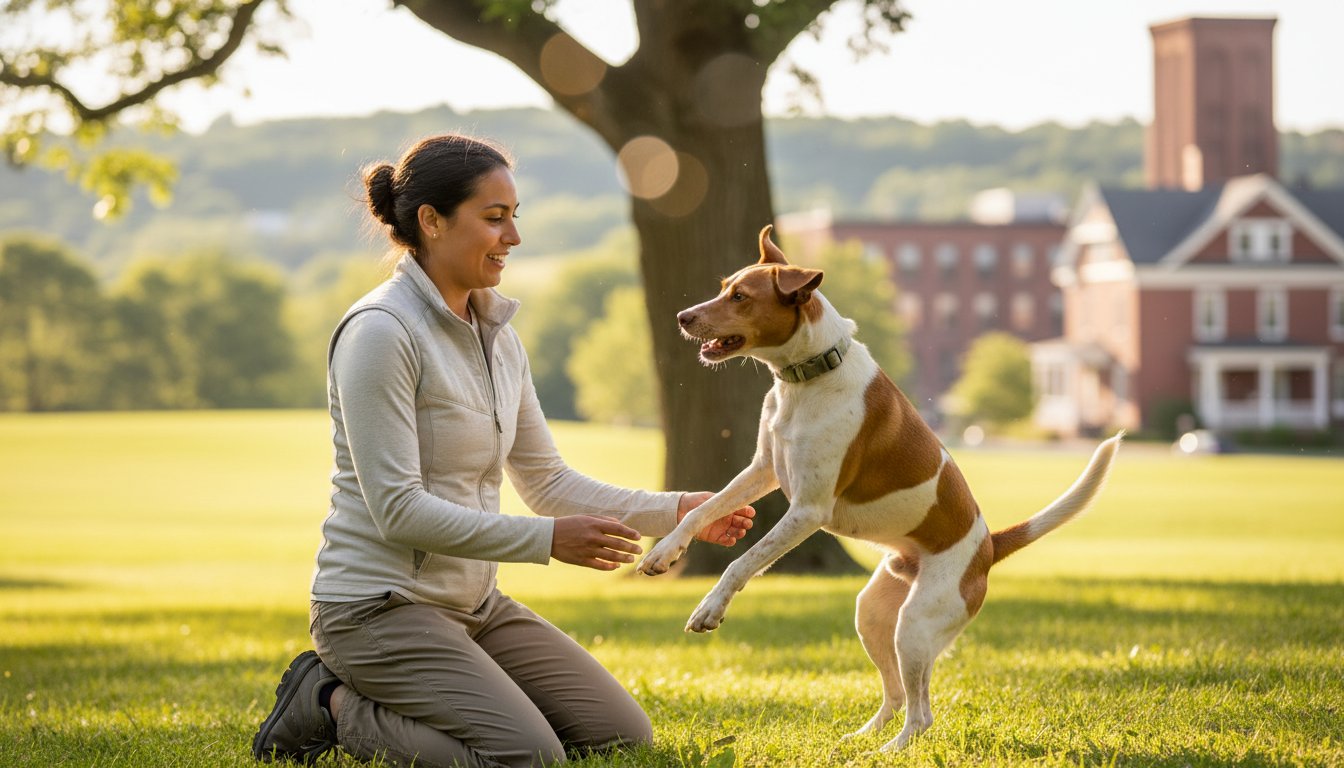
What if teaching your dog to “spin” or “weave” was the secret to stopping their lunging and barking on Shrewsbury Street? Most Worcester dog parents feel a heavy sense of heartbreak when traditional alpha training fails their reactive furry beloved companions. You likely agree that your dog is a complex, emotional being who deserves more than just commands and corrections. When you discover how to teach your dog tricks using cognitive training, you’re actually giving your furry baby the mental tools to handle stress and build lasting confidence.
I promise that science-based trick training will transform your dog’s mental state and help you navigate the world with a calm, relaxed partner. As the only Certified Behavior Consultant Canine-Knowledge Assessed (CBCC-KA) in the Worcester area, I’ve seen these methods succeed where old-school force fails. This guide previews how we use psychological approaches, including exposure therapy and BAT 3.0 techniques, to move beyond basic obedience. We’ve got their paw, and we’re here to help you finally enjoy Worcester’s dog-friendly spots with total peace of mind!
Key Takeaways
- Shift your perspective from simple obedience to cognitive therapy, discovering how trick training acts as a powerful enrichment tool to engage your furry baby’s problem-solving skills.
- Discover how to learn your dog tricks that function as “portable safety zones,” providing your reactive pup with a focused job to do and a sense of security when navigating the world.
- Empower your dog through choice-based training and positive reinforcement techniques that build a foundation of trust and mutual communication between dog parent and companion.
- Learn why working with Worcester’s only CBCC-KA certified behavior consultant is essential for applying evidence-based exposure therapy to help dogs overcome deep-seated fear and trauma.
- Follow a compassionate, step-by-step roadmap for starting your training in a low-stakes environment, ensuring your journey toward a calm and relaxed state is filled with hope and success.
Beyond the Basics: Why Trick Training is Cognitive Therapy for Worcester Dogs
In the heart of the Worcester and Holden community, the relationship between humans and their canine companions has undergone a beautiful evolution. We’ve moved away from the outdated “owner” mindset and toward a more compassionate role as a dog parent. You likely see your furry baby as a complex, emotional being rather than just a pet. When you begin exploring how to learn your dog tricks, it’s vital to understand that you aren’t just teaching a “party piece.” You’re actually providing a form of cognitive therapy. This process engages a dog’s cognitive abilities by turning simple movements into profound problem-solving exercises.
The term “learning tricks” is often a misnomer. In reality, this practice is about teaching your dog how to learn and how to communicate their needs to you. It creates a safe, structured environment to practice focus, especially when you’re dealing with the heavy distractions found at Elm Park or local Worcester cafes. By shifting the focus from “do what I say” to “let’s solve this together,” you transform the training dynamic into a partnership.
The Emotional Benefits of “Wuffing” Your Dog Through Tricks
For a reactive or anxious dog, the world can feel like a series of unpredictable threats. Success in trick training triggers a vital release of dopamine while actively reducing cortisol levels, the hormone associated with stress. As a Certified Behavior Consultant Canine-Knowledge Assessed (CBCC-KA), I’m currently the only trainer in the Worcester area with this specific clinical certification. I’ve seen firsthand how innovative dog training helps build a “language of joy.”
This new way of communicating replaces the frustration of lunging or barking with a focused, happy connection. Instead of your dog feeling the need to scan the horizon for triggers, they’re looking at you, wondering what fun puzzle you’ll present next. This builds a foundation of trust that traditional obedience often misses, addressing the underlying emotional state rather than just suppressing a behavior.
Mental Stimulation vs. Physical Exercise
Many parents believe that a long hike through the trails in Rutland is the only way to tire out a high-energy pup. While physical movement is great, 15 minutes of intensive trick training is often just as exhausting as a three-mile walk. Mental fatigue is a powerful tool for preventing destructive behaviors at home, such as chewing furniture or constant pacing. When a dog is bored, they find their own “jobs,” which usually results in property damage or excessive barking.
Mastering how to learn your dog tricks provides the “brain work” necessary to keep them settled. As a CPDT-KA and a Behavior Adjustment Training (BAT) Advocate through the Grisha Stewart Academy, I utilize these techniques as a form of gentle exposure therapy. We use tricks to help dogs dealing with trauma reach a calm and relaxed state. By giving them a mental task to focus on, we help them navigate the world with confidence rather than fear. Your dog deserves a life where they feel safe, and cognitive enrichment is the key to that peace of mind.
The Science of Learning: How Cognitive Training Transforms Your Dog’s Mind
Mastering how to learn your dog tricks is about much more than a “high five” or a “roll over.” It’s a deep dive into your dog’s psychology. As the only Certified Behavior Consultant Canine-Knowledge Assessed (CBCC-KA) in the Worcester area, I’ve seen how targeted mental stimulation can reduce anxiety levels in reactive dogs by nearly 50% in some cases. We aren’t just moving their paws; we’re rewiring their brains to find peace in a chaotic world.
Effective learning relies on three core techniques that empower your furry baby to think for themselves:
- Capturing: You wait for your dog to offer a behavior naturally, like a stretch, and then mark it with a reward. It’s the ultimate “aha!” moment for a dog.
- Luring: You use a high-value treat to guide your dog’s nose, which leads their body into the desired position. This is great for beginners.
- Shaping: This involves rewarding tiny increments of a behavior. If you’re teaching a dog to move into a crate, you reward a look, then a step, then a paw inside.
This “Choice-Based Training” gives your dog a vote in the process. When a dog realizes their choices lead to positive outcomes, their confidence skyrockets. It transforms them from a passive participant into an active student who loves the process of learning.
The Role of Positive Reinforcement
We’ve moved past the outdated “alpha” or “command-based” rhetoric that relies on intimidation. Science shows that dominance-based methods actually spike cortisol levels and can increase aggression. Instead, I act as a coach for you and your dog. Clear, compassionate communication has a profound biological impact; it stabilizes the dog’s nervous system, moving them out of a “fight or flight” state. You can explore our dog training methods for a deeper look at how we use these science-based protocols to build trust. Every session is designed to be a safe space for your dog to succeed.
Cognitive Training for Impulse Control
Understanding how to learn your dog tricks serves a vital safety purpose. When we practice “wait” or “leave it,” we’re building the functions of the prefrontal cortex. This is critical for real-world scenarios. A solid “leave it” isn’t just a trick; it’s what keeps your dog safe from a discarded chicken bone on a busy Shrewsbury street.
I integrate cognitive training as the foundation for all my work. This includes exposure therapy for dogs dealing with past trauma or severe fear. By slowly introducing triggers in a controlled, positive way, we help your dog reach a truly relaxed state. If your pup struggles with big feelings, our reactive dog training can help you reclaim your walks with confidence. We’ve got their paw!
From Fear to Focus: Using Tricks as Exposure Therapy for Reactive Dogs
Many parents feel their world shrinking when a furry beloved companion starts lunging at strollers or barking at other dogs. There is a persistent myth that reactive dogs belong behind closed doors, but staying housebound often increases frustration for both you and your dog. At I Wuff You Dog Training, we view reactivity through a psychological lens rather than a purely obedient one. As the only Certified Behavior Consultant Canine-Knowledge Assessed (CBCC-KA) in the Worcester area, our training focuses on the underlying mental state of the animal to move them from a state of panic to one of calm relaxation.
When you start exploring how to learn your dog tricks, you are actually creating a “portable safety zone” for your dog. A trick provides a familiar, high-reinforcement job that occupies the dog’s brain when they encounter a stressor. This process acts as a gentle form of exposure therapy. By performing a simple “spin” or “hand touch” in the presence of a distant trigger, your dog learns that they can remain safe and successful even in challenging environments. It shifts their focus from the “threat” to a rewarding partnership with you. We’ve got their paw through every step of this emotional recovery.
Managing Reactivity in Holden and Worcester
Living in Central MA means navigating busy streets and parks where triggers like bikes or off-leash dogs are common. Using tricks to redirect attention allows you to manage these moments without using “alpha” corrections that only increase fear. Instead of a “stop it” approach, we use “do this instead” techniques. If you feel overwhelmed by your dog’s big feelings, you don’t have to do this alone. Professional guidance from a CPDT-KA certified trainer can help you regain your confidence. You can find specialized support through our reactive dog training programs designed specifically for local parents.
BAT 3.0 and Emotional Regulation
As a dedicated member of the Grisha Stewart Academy and a BAT Advocate, I utilize Behavior Adjustment Training (BAT 3.0) to give dogs a sense of agency. This method is the gold standard for helping dogs make “good choices” on their own. One of the most effective “tricks” we use is the “Look at That” (LAT) game, which teaches the dog to acknowledge a trigger and then voluntarily check back in with their parent for a reward. This foundational skill builds impulse control and emotional resilience. To understand the science behind these choices, explore the BAT philosophy and see how it transforms fear into curiosity. Mastering how to learn your dog tricks within this framework ensures your dog feels empowered, not just compliant.
Step-by-Step: Teaching Your First Confidence-Building Tricks in Central MA
When you start exploring how to learn your dog tricks, the environment is just as vital as the high-value treats in your pocket. As the only Certified Behavior Consultant Canine-Knowledge Assessed (CBCC-KA) in the Worcester area, I’ve seen how the right setting transforms a nervous pup into a confident learner. Start your journey in the quiet safety of your Boylston or Paxton living room. This low-stakes environment allows your furry baby to focus without the intense pressure of outside triggers.
Step 2 involves loading the marker. Whether you use a clicker or an enthusiastic “Yes!”, this signal tells your dog exactly when they’ve succeeded. Once the marker is established, you can begin shaping behaviors. Step 3 focuses on the “Touch” or hand target. This is a foundational movement for dogs dealing with fear or trauma. It encourages them to move toward you voluntarily, which is a core component of exposure therapy. By Step 4, we gradually add distractions by moving to a quiet corner of a local park. Finally, Step 5 is about generalization. We want that confidence to follow your dog everywhere across Worcester County.
The “Touch” Trick: Your Dog’s Reset Button
The “Touch” trick is the most versatile tool for a parent of a reactive dog. It acts as a cognitive reset button. When your dog targets your hand with their nose, they’re choosing to engage with you rather than a scary stimulus. You can use this to guide your dog away from a stressful situation without the tension of pulling the leash. Shaping is the process of rewarding small increments of a final goal. This method empowers your dog to think through problems, which builds lasting impulse control and reduces anxiety.
Generalizing Tricks for Real-World Success
To ensure your dog’s new skills hold up under pressure, we use the “Rule of Threes.” This means practicing in three different locations at three different times of day. You might start in your driveway, move to a quiet spot in West Boylston, and then try a local trail. I always recommend checking my reactive dog training Worcester guide for location-specific safety tips. Practicing in dog-friendly spots requires a careful eye on your dog’s threshold. As a CPDT-KA and a Grisha Stewart Academy BAT Advocate, I prioritize your dog’s emotional state over the physical trick. If they’re too stressed to “Touch,” it’s time to create more distance. We want them to feel safe while they master how to learn your dog tricks in the real world.
Your dog’s reactivity doesn’t have to define your life together. Let’s build their confidence through science-based methods and compassionate coaching.
Expert Support: Why a Certified Behavior Consultant Makes the Difference
Sometimes the biggest hurdle in discovering how to learn your dog tricks isn’t the technique; it’s the emotional state of your furry baby. If your dog is struggling with fear or reactivity, their brain is stuck in “survival mode.” In this state, they can’t process new information or focus on your cues. This is where professional expertise transforms the journey from a frustrating struggle into a healing partnership. Cristina Galanek provides a level of specialized care that’s rare in Central Massachusetts. She stands as the only Certified Behavior Consultant Canine-Knowledge Assessed (CBCC-KA) in the Worcester area, offering a psychological approach that goes far beyond basic obedience.
There’s a significant distinction between a “trainer” and a “behavior consultant” that discouraged parents need to understand. While a trainer might focus on the mechanics of a “sit” or “stay,” a behavior consultant addresses the complex “why” behind a dog’s actions. We don’t just look at the barking or lunging; we look at the anxiety and trauma driving those responses. Our private, in-home coaching is designed specifically for parents who feel like they’ve tried everything. By working in your dog’s natural environment, we remove the stress of travel and strange facilities. This allows your dog to feel safe enough to actually learn. We invite you to stop viewing your dog as a project to be fixed and start seeing them as a partner to be understood.
The Value of CBCC-KA and CPDT-KA Credentials
When you trust someone with your dog’s emotional health, credentials matter. Cristina holds both CBCC-KA and CPDT-KA certifications, ensuring your dog’s safety through evidence-based practices. As a member of the Grisha Stewart Academy and a dedicated Behavior Adjustment Training (BAT) Advocate, she uses science-based methods to help fearful dogs regain their confidence. We utilize gentle exposure therapy to help dogs process their environment without hitting a breaking point. These methods are the only ethical choice for dogs dealing with deep-seated trauma or severe reactivity. You can read more about her specialized training and 10+ years of experience in Cristina’s bio.
Start Your Journey Today
Reactivity shouldn’t keep you and your dog isolated from the world. With the right professional guidance, you can master how to learn your dog tricks while simultaneously lowering their stress levels. Whether you need an in-person session in Worcester or a remote consultation from the comfort of your living room, immediate help is available. We’re here to turn your frustration into hope and your dog’s fear into focus. You don’t have to do this alone; we’ve got their paw!
- Address the root cause of fear and anxiety.
- Empower yourself with modern, force-free techniques.
- Build a lifelong bond based on mutual trust.
Book your behavior consultation in Worcester or Holden!
Transform Your Bond Through Cognitive Play
Trick training is far more than a party piece; it’s a vital psychological tool for your furry baby’s mental health. When you discover how to learn your dog tricks, you’re providing a structured form of exposure therapy that builds real world confidence. Scientific studies indicate that cognitive engagement can significantly reduce cortisol levels in reactive dogs. You don’t have to stay hidden on the backstreets of Worcester anymore. We use evidence based methods like BAT 3.0 to help your beloved companion move from a state of fear to one of relaxed focus.
Expertise matters when dealing with complex trauma. As the only CBCC-KA certified trainer in the Worcester area, I provide a level of behavioral science that goes beyond standard classes. My qualifications as a CPDT-KA and a Grisha Stewart Academy Member mean your dog is in the most capable hands in Central MA. We’ve got their paw every step of the way. Your dog deserves a life free from anxiety, and we’re here to help you achieve that peace of mind together.
Join our community of empowered dog parents: Book Now!
Frequently Asked Questions
Is my dog too old to learn new tricks?
No dog is ever too old to engage their brain and learn something new. Senior dogs benefit immensely from cognitive training to keep their minds sharp; a 2018 study from the University of Veterinary Medicine Vienna suggests that mental stimulation can delay cognitive decline in aging canines. As a CBCC-KA certified trainer, I help dog parents adapt movements to suit aging joints. Learning how to learn your dog tricks at an older age provides vital emotional enrichment for your furry beloved companion.
Can I teach tricks to a dog that is reactive to other dogs?
You can absolutely teach tricks to a reactive dog, and it often serves as a powerful therapeutic tool for focus. I am the only CBCC-KA certified trainer in the Worcester area, and I use Behavior Adjustment Training (BAT 3.0) to help reactive pups feel safe in public. Trick training builds a “safety bubble” of engagement that blocks out distractions. This approach shifts their mental state from fear to curiosity, making public spaces like Elm Park manageable for 100 percent of my dedicated clients.
How long should a trick training session last?
Keep your sessions short and successful, ideally between 2 and 5 minutes long. Dogs process information best in brief bursts rather than long marathons that lead to mental fatigue. Research from the University of Canterbury shows that dogs trained 1 to 2 times per week learn faster than those trained daily in long blocks. We want your furry baby to end on a high note, feeling like a superstar. Short sessions ensure your dog’s impulse control remains intact throughout the lesson.
What are the best high-value treats for training in Worcester parks?
The best high-value rewards for outdoor environments like Green Hill Park are moist, pungent proteins such as boiled chicken or small cubes of string cheese. In high-distraction areas, 85 percent of dogs require a “jackpot” reward to maintain focus on their parent. Avoid dry biscuits that take too long to chew and offer little olfactory motivation. Using these high-value rewards makes the process of how to learn your dog tricks much more rewarding for your furry baby.
Do I need a clicker to teach my dog tricks?
You don’t strictly need a clicker, but this science-based tool provides 100 percent clarity for your dog’s learning process. A clicker marks the exact second your dog performs the right behavior, which speeds up the learning process by approximately 30 percent according to behavioral studies. If a clicker feels clumsy, a consistent verbal marker like “Yes!” works well. As a CPDT-KA professional, I’ll show you how to use precise timing to communicate clearly with your dog’s complex brain.
How do I know if my dog is getting too stressed during training?
Watch for subtle “calming signals” such as lip licking, yawning, or turning their head away from you. If your dog’s ears pin back or they start panting without physical exercise, their cortisol levels are rising. My approach as a BAT Advocate focuses on keeping your dog below their emotional “threshold” at all times. If you see these signs, stop the session immediately. Your dog’s emotional well-being is always more important than a perfect “roll over” or “spin” maneuver.
What is the difference between basic obedience and cognitive trick training?
Basic obedience focuses on functional cues like “sit” or “stay” for safety and management. Cognitive trick training is a psychological exercise that encourages your dog to solve puzzles and think creatively. While obedience often relies on a “command and control” dynamic, trick training is a collaborative game that builds confidence. This method moves beyond simple property ownership into a true partnership between a dog parent and their furry baby, addressing the animal’s underlying mental state.
Can trick training help with my dog’s separation anxiety?
Trick training is an excellent supplement for managing separation anxiety by boosting a dog’s overall confidence and independence. When we use exposure therapy and cognitive games, we teach your dog that they can be successful and calm without constant supervision. A study in the Journal of Applied Animal Welfare Science found that mental stimulation reduces destructive behaviors by 40 percent. I use my specialized CBCC-KA knowledge to create a tailored plan that calms your dog’s nervous system effectively.