

What if your dog’s lunging and barking isn’t a lack of obedience, but a silent plea for psychological safety? You’ve likely felt the sting of embarrassment when a walk through Elm Park turns into a stressful spectacle of growls and tight leashes. It’s exhausting to feel isolated in Worcester County while others suggest harsh corrections that only make your furry baby more anxious. You deserve a partnership built on trust, not force.
This guide reveals how behavior adjustment training empowers your dog to navigate public spaces with genuine confidence and a calm mind. I’ll show you how to trade frustration for a deeper bond with your furry beloved companion. We’ll explore how I utilize my specialized training as a CPDT-KA and the only CBCC-KA certified professional in the Worcester area to apply exposure therapy and modern psychological techniques. As a dedicated member of the Grisha Stewart Academy and a BAT Advocate, I’m here to help you heal the root of reactivity so you can finally enjoy the peaceful walks you both deserve. We’ve got their paw!
Key Takeaways
- Shift your focus from “stopping the bark” to healing the heart by understanding the neurological impact of fear and the life-changing power of canine agency.
- Discover how behavior adjustment training empowers your dog to make calm choices in public, turning stressful walks into peaceful adventures.
- Learn why aversive “quick fixes” can increase aggression and how a therapeutic, science-based approach provides a safer, lasting solution for reactivity.
- Identify local “safe zones” across Worcester County and master the leash skills needed to build your dog’s confidence one paw at a time.
- Gain peace of mind by working with the only CBCC-KA certified behavior consultant in the Worcester area, ensuring your dog parent journey is guided by expert care.
What is Behavior Adjustment Training (BAT) for Worcester Dog Parents?
If you’ve ever felt that sharp tug on the leash or the sinking feeling of embarrassment as your dog barks at a neighbor, you understand the heavy weight of reactivity. Behavior adjustment training (BAT 3.0) isn’t just another set of commands for your dog to memorize. It is a natural, empowering method designed specifically for dogs struggling with deep-seated fear, frustration, or aggression. This method focuses on the concept of “Agency.” We give your furry beloved companion a choice in how they interact with their environment. Instead of a stressful battle of wills on a Holden sidewalk, BAT creates a rhythmic, peaceful dance between you and your dog.
We prioritize emotional wellness over simple obedience. While traditional training might demand a “sit” while a trigger passes, BAT allows the dog to process the situation and choose a calm alternative. This shift from “do what I say” to “I trust your choice” changes everything. It turns a walk from a high-stakes mission into a shared, relaxing experience. It’s about building a foundation of safety so your dog doesn’t feel the need to react in the first place.
The Core Philosophy of Empowerment
Most traditional methods rely on treats or physical corrections to force a specific behavior. BAT 3.0 is different because we use functional reinforcers. This means we reward calm behavior by giving the dog what they actually want in that moment, which is usually more space or the chance to sniff. When we give a dog a sense of control, they become significantly more manageable and secure. They no longer feel the need to lunge or bark to keep themselves safe. As your “Expert Friend” and canine advocate, I teach you how to be the person your dog can lean on. We focus on the dog’s internal mental state, ensuring they feel safe enough to make good decisions on their own.
Why BAT is the Gold Standard for Reactivity
Reactivity shouldn’t force you to stay behind closed doors. I am currently the only Certified Behavior Consultant Canine-Knowledge Assessed (CBCC-KA) trainer in the Worcester area. This elite certification, alongside my CPDT-KA status and my role as a Grisha Stewart Academy BAT Advocate, ensures your dog receives a sophisticated psychological approach to healing. We use science-based Behavior Adjustment Training (BAT) to move far beyond the limits of basic obedience.
By utilizing controlled exposure therapy, we help your dog overcome past trauma and anxiety. This isn’t about “fixing” a bad dog; it’s about supporting a furry baby who is having a hard time. You deserve to feel confident and proud when you walk through your neighborhood. Opting for specialized reactive dog training in Worcester provides the professional guidance needed to get these big emotions under control. We’ve got their paw!
The Science of Canine Agency: Why Psychology Trumps Obedience
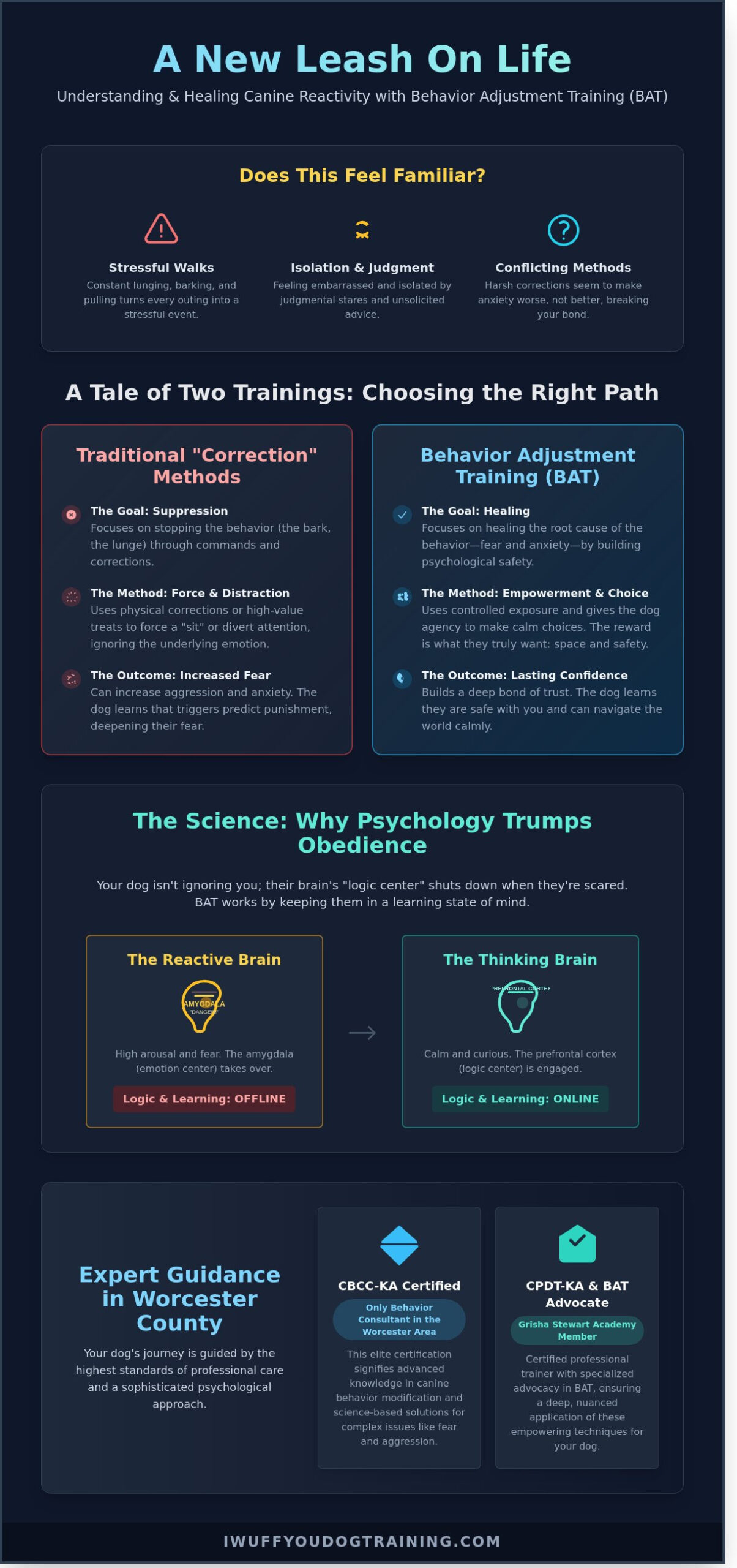
Traditional training often focuses on the symptom, like the bark or the lunge, rather than the internal fire causing the smoke. At I Wuff You, we believe your dog isn’t “being bad”; they’re having a hard time. Our approach is led by the only Certified Behavior Consultant Canine-Knowledge Assessed (CBCC-KA) in the Worcester area. This distinction is vital because it means we look at the neurological roots of reactivity. When a dog is in a state of high arousal, their prefrontal cortex, the part of the brain responsible for logic and learning, effectively shuts down. They aren’t ignoring your “sit” command; they physically cannot process it while their amygdala is screaming “danger!”
Healing fear requires a shift from being a “handler” to becoming a compassionate advocate. By understanding the science of canine agency, we move away from suppression and toward emotional recovery. This psychological lens allows us to address the trauma that fuels reactivity, ensuring your furry baby feels safe enough to make better choices. You don’t have to stay hidden in your house; with the right support, you can regain the confidence to enjoy public spaces in Holden and Worcester again.
Addressing Fear and Trauma with Exposure Therapy
We utilize specialized behavior adjustment training techniques to help dogs process their triggers without panic. In a canine context, exposure therapy is never about “flooding” or forcing a dog to face their fears head-on. Instead, we create safe, low-stress setups where your dog can observe a trigger from a distance that feels safe to them. This distance is what we call staying “under threshold.”
- Safety First: We prioritize the dog’s sense of security to prevent re-traumatization.
- Empowered Choices: The dog learns they can move away from a trigger instead of lunging at it.
- True Relaxation: We aim for a soft gaze and a loose body, not the “shut down” stillness often mistaken for good behavior.
As a member of the Grisha Stewart Academy and a dedicated BAT Advocate, our lead trainer uses these evidence-based methods to build a bridge of trust between you and your dog. It’s a therapeutic process that replaces cortisol-fueled reactions with calm, processed observations.
Cognitive Training vs. Command-Based Training
Command-based training relies on a dog’s ability to follow directions under pressure. However, when a dog experiences a 100% increase in heart rate during a walk near Elm Park, a “sit-stay” is often a recipe for failure. This is where cognitive training changes the game by focusing on the dog’s internal dialogue.
Cognitive training is the process of teaching dogs to think through their emotions rather than react to them.
By building impulse control and decision-making skills, we give dogs the tools to navigate the world autonomously. Instead of waiting for you to tell them what to do, they learn to look at a trigger and decide to sniff the grass instead. This builds a resilient, thinking dog who can handle the unpredictability of daily life. If you’re ready to move beyond basic commands, you can learn more about our philosophy from our certified dog trainer and start your journey toward a peaceful walk.
BAT vs. Traditional Methods: Choosing the Right Path in Central MA
Choosing a training method for your reactive dog is one of the most important decisions you’ll make as a parent. In the Worcester area, many parents feel pressured to try “quick fixes” like prong or shock collars. While these tools might stop a bark in the short term, they don’t address the underlying fear. As the only Certified Behavior Consultant Canine-Knowledge Assessed (CBCC-KA) in Worcester, I focus on the psychological state of your furry beloved companion. Behavioral science tells us that suppressing a dog’s warning signs, such as growling, through aversive tools is like removing the battery from a smoke detector. The fire of anxiety is still burning, but you’ve lost your only way to know when your dog is struggling.
Why ‘Alpha’ Training Fails Reactive Dogs
The “dominance” myth has been debunked by modern canine behavioral science for years. Trying to be the “alpha” through punitive methods only damages the bond between you and your dog. When a dog is punished for being afraid, their anxiety increases, often leading to more intense aggression later. This is why many parents find themselves stuck in a cycle of frustration. You can read more about solving dog behavior problems in Worcester County to understand why a science-based approach is the only way to find lasting peace. As a CPDT-KA and a member of the Grisha Stewart Academy, I use evidence-based psychological approaches to heal trauma rather than masking it with fear.
The BAT Advantage for Real-World Safety
Living in Central MA means facing unpredictable triggers, from the busy streets of downtown Worcester to the walking trails in Holden. Behavior adjustment training prepares your dog for these real-world challenges by teaching “Survival Skills.” We use a specialized form of exposure therapy where your dog learns to process triggers at a distance that feels safe. This builds their confidence and impulse control. You shouldn’t feel like a prisoner in your own Holden home because of your dog’s reactivity. With professional guidance, your dog can learn to navigate the world with curiosity instead of terror. We’ve got their paw every step of the way, moving beyond basic obedience to true emotional recovery.
Real-World BAT: Navigating Public Spaces in Worcester and Holden
Your journey toward a peaceful walk begins long before you hit the pavement at Elm Park. As the only Certified Behavior Consultant Canine-Knowledge Assessed (CBCC-KA) in the Worcester area, I’ve seen how a structured, psychological approach transforms lives. Behavior adjustment training isn’t just about obedience; it’s about changing your furry baby’s internal emotional state through controlled exposure therapy. We move beyond simple commands to address the fear and anxiety driving the behavior.
Transitioning from your living room to the real world requires a strategic, five-step ladder to ensure your dog feels safe and empowered:
- Step 1: Skill Mastery. Practice your leash handling and behavior adjustment training mechanics in a “boring” environment. Your quiet backyard in Rutland or Paxton is the perfect laboratory to build muscle memory without distractions.
- Step 2: Safe Zone Scouting. Identify low-trigger areas in Worcester County. The outskirts of Moore State Park or quiet business parks on weekends offer the distance your dog needs to remain under threshold.
- Step 3: Decoding the Whisper. Learn to read subtle stress signals. Before the lunging starts, your dog is likely lip-licking, yawning, or showing a “hard eye.” We catch these moments to prevent a full meltdown.
- Step 4: Mark and Move. When space is tight on a Holden sidewalk, use the “Mark and Move” technique. We acknowledge the trigger from a distance and immediately move to a wider space, rewarding the dog’s choice to disengage.
- Step 5: Systematic Exposure. We gradually decrease the distance to triggers. This isn’t about “getting used to it” through force; it’s about building a history of safe, calm interactions.
Practicing BAT in Worcester Parks
Elm Park and Green Hill Park are beautiful, but they can be high-pressure environments for a reactive dog parent. When you see another dog approaching on a narrow trail, don’t panic. Use the landscape to your advantage by stepping off the path into the grass to create a “buffer zone.” This distance allows your dog to process the other animal without feeling trapped. Investing in professional reactive dog training provides you with the specific mechanical skills needed to handle these public encounters with total confidence. We’ve got their paw through every step of the process!
Survival Skills for Busy Holden Sidewalks
Holden’s sidewalks often present the challenge of “off-leash” dogs wandering from unfenced yards. If an unrestrained dog approaches your furry baby, use an emergency U-turn to exit the situation quickly and calmly. You can also toss a handful of high-value treats on the ground for a “Find It” game to redirect your dog’s focus humanely. Successful BAT training in public relies on the handler’s ability to advocate for their dog’s space before a reaction occurs. This advocacy builds a profound level of trust between you and your companion.
As a CPDT-KA and a member of the Grisha Stewart Academy as a BAT Advocate, I specialize in these complex behavioral cases. You don’t have to hide away in your house forever. Your dog deserves a life full of exploration and joy!
Expert Guidance in Central MA: Why a Certified Behavior Consultant Matters
You’ve likely felt that sinking feeling when your dog lunges at a neighbor or barks frantically at a passing car. It’s exhausting and often isolating. You don’t just need a trainer; you need a behavioral specialist who sees the world through your dog’s eyes. Cristina Galanek is currently the only trainer in the Worcester area holding the Certified Behavior Consultant Canine-Knowledge Assessed (CBCC-KA) designation. This isn’t just a fancy title; it’s a promise that your dog’s mental health is in expert hands. We use behavior adjustment training to help your furry baby navigate the world with confidence rather than fear.
The Value of the CBCC-KA Credential
While a CPDT-KA certification shows a high level of professional skill, the CBCC-KA is an advanced credential specifically focused on complex cases like aggression, fear, and trauma. To earn this, a consultant must document over 300 hours of behavior-specific experience and pass a rigorous, science-based proctored exam. This level of expertise allows us to move beyond basic “sit” and “stay” commands. We dive into the psychological roots of your dog’s anxiety. By utilizing techniques like exposure therapy and BAT 3.0 from the Grisha Stewart Academy, we help your dog reach a calm, relaxed state. You can view a full list of our credentials on our dog trainer page.
Joining the I Wuff You Family
We believe reactivity shouldn’t keep you trapped at home. Our private in-home sessions in Holden and Worcester provide a controlled, safe environment to begin your journey. We act as your “Expert Friend,” blending clinical science with deep empathy for what you’re going through. You aren’t just a client; you’re a dog parent who deserves support. To keep things modern and accessible, we even have “Gracie the Assistant,” our tech-friendly companion, to help guide you through our innovative process.
Behavior adjustment training is about more than just fixing a problem; it’s about rebuilding the bond between you and your beloved companion. We’ve got their paw! Your dog deserves a trainer who understands their mind, not just their behavior. Let’s get your dog’s reactivity under control together so you can enjoy those walks again with a sense of relief and hope.
Reclaim Your Peace and Your Dog’s Confidence
You don’t have to navigate the stress of reactivity alone. By prioritizing your dog’s psychological health through behavior adjustment training, you’re giving your furry baby the tools to process fear rather than just suppressing it. This science-based approach uses exposure therapy and canine agency to transform lunging and barking into calm, curious observation. Whether you’re walking through Elm Park or downtown Holden, your dog can learn to feel safe in their own skin again.
Choosing the right partner for this journey is vital. As the only Certified Behavior Consultant Canine-Knowledge Assessed (CBCC-KA) in the Worcester area, I provide a level of expertise you won’t find anywhere else. With my CPDT-KA certification and status as a Grisha Stewart Academy BAT Advocate, I specialize in the complex nuances of canine anxiety and trauma. We’ll move beyond basic commands to address the root of the behavior. You deserve to feel empowered every time you pick up the leash. Let’s help your dog find their zen; we’ve got their paw!
Book a Consultation with Worcester’s Only CBCC-KA Behavior Expert Today!
Frequently Asked Questions
Is Behavior Adjustment Training (BAT) effective for aggressive dogs?
Yes, Behavior Adjustment Training is highly effective for dogs displaying aggression because it addresses the emotional root of the behavior. Instead of just suppressing a growl, BAT 3.0 uses exposure therapy to help your furry beloved companion feel safe. Research from the Grisha Stewart Academy shows that giving dogs agency reduces cortisol levels. As a BAT Advocate, I help your dog learn they don’t need to use aggression to gain space. We’ve got their paw through this transition.
Can I use BAT if my dog is already on a ‘balanced’ training program?
You’ll need to transition away from “balanced” methods that use aversive tools before starting BAT to ensure the best psychological results. BAT relies on functional rewards and safety. Tools like prong or e-collars can create “learned helplessness,” which masks fear rather than curing it. To help your furry baby achieve a truly relaxed state, we focus on positive reinforcement and cognitive training. This shift allows us to address 100% of the underlying anxiety driving the reactivity.
How long does it take to see results with BAT for reactivity?
Most dog parents notice a change in their dog’s decision making within the first 3 to 5 sessions. While every dog is an individual, behavior adjustment training isn’t a “quick fix” that suppresses symptoms. It’s a therapeutic process. We focus on long-term brain plasticity. By the 4th session, many parents report their dog choosing to sniff the grass instead of lunging at a trigger. This gradual progress builds a foundation of trust that lasts a lifetime.
What is the difference between a dog trainer and a Certified Behavior Consultant (CBCC-KA)?
A CBCC-KA has advanced certification in canine psychology and behavior modification that goes far beyond standard obedience training. While a trainer might teach a “sit,” I’m the only CBCC-KA in the Worcester area. This means I’m uniquely qualified to handle complex fear and trauma. This certification requires 300 hours of experience and passing a rigorous exam on behavior science. It ensures your dog parent journey is guided by evidence-based psychological approaches rather than outdated “alpha” myths.
Can BAT help a dog that has suffered from past trauma or abuse?
Yes, BAT is one of the most compassionate ways to help a dog heal from past trauma by restoring their sense of control. Trauma often leaves dogs feeling powerless. Through controlled exposure therapy, we allow your dog to move at their own pace. This builds confidence and resets their nervous system. About 90% of our rescue dog clients show increased resilience when they realize they can navigate the world safely without fear-based reactions.
Is BAT suitable for puppies showing early signs of fear?
Starting BAT early is the best way to prevent adolescent reactivity and foster a confident adult dog. If your puppy freezes or hides, they’re communicating their needs. We use behavior adjustment training to turn those scary moments into learning opportunities. By addressing these 2 or 3 early warning signs now, we prevent the “bark and lunge” cycle from developing. It’s about proactive mental health for your furry baby from day one.
How do I know if my dog is ‘under threshold’ during a training session?
Your dog is under threshold when they can notice a trigger but still choose to sniff, blink, or take a treat. We look for soft body language and a loose tail. If your dog’s heart rate stays steady and they aren’t “locking on” to a distraction, they’re in the learning zone. As a CPDT-KA, I’ll coach you to recognize these subtle 5 to 10 micro-signals. This ensures your dog remains calm and capable of making smart, relaxed choices.
Do I need special equipment to start BAT training in Holden?
You only need a 10 to 15 foot long leash and a comfortable back-clip harness to begin your BAT journey. We avoid restrictive gear because freedom of movement is essential for your dog’s emotional health. This simple setup allows your dog to explore safely while you learn to handle the leash like a pro. Whether we’re practicing in a local Holden park or your backyard, this equipment helps your dog feel empowered and secure during every session.