

Imagine it’s a Saturday morning at Elm Park, but instead of enjoying the sunshine, you’re scanning every corner with a racing heart, ready to duck behind a tree because another dog appeared 50 yards away. It’s heartbreaking to see your furry baby in such distress, and the judgment from neighbors when they react only adds to the weight you carry. When addressing fear and anxiety in dogs a psychological approach is the essential bridge between managing symptoms and achieving true emotional healing. You deserve to feel empowered, not trapped; your dog deserves to feel safe in their own skin.
I know you want a calm, relaxed companion who can enjoy the beautiful trails of Central Massachusetts without a meltdown. As the only Certified Behavior Consultant Canine-Knowledge Assessed (CBCC-KA) in the Worcester area, I combine my CPDT-KA credentials and status as a Grisha Stewart Academy BAT Advocate to offer more than just basic obedience. Discover how a science-based psychological approach can help your fearful dog find calm and confidence. We’ll explore how evidence-based techniques like exposure therapy and Behavior Adjustment Training help your dog process trauma and find peace. It’s time to stop hiding and start healing the bond you share!
Key Takeaways
- Understand the biological “why” behind your furry baby’s stress by exploring fear and anxiety in dogs a psychological approach that prioritizes emotional well-being over simple obedience.
- Discover why traditional “sit and stay” commands fail a panicked dog and how to avoid aversive training methods that can worsen deep-seated psychological trauma.
- Learn about the specialized expertise of Cristina Galanek—the only CBCC-KA certified trainer in the Worcester area—and why advanced behavioral credentials are vital for your dog’s recovery.
- Explore evidence-based strategies like BAT 3.0 and exposure therapy that empower reactive dogs to process trauma safely and regain their confidence in public spaces.
- Gain practical, compassionate tips for navigating neighborhoods in Worcester and Holden, helping you and your dog transition from discouragement to empowered, calm adventures.
Understanding the Canine Mind: The Psychology of Fear and Anxiety
Living with a fearful dog in Worcester County can feel isolating. You might feel judged when your furry beloved companion barks at a cyclist on Park Ave or lunges at a neighbor in Holden. As the only Certified Behavior Consultant Canine-Knowledge Assessed (CBCC-KA) currently practicing in the Worcester area, I want you to know that your dog isn’t “bad.” They are struggling. Taking a fear and anxiety in dogs a psychological approach means looking past the surface behaviors to see the emotional distress underneath. My work as a CPDT-KA and a Grisha Stewart Academy BAT Advocate focuses on healing the mind, not just suppressing symptoms. We’ve got their paw!
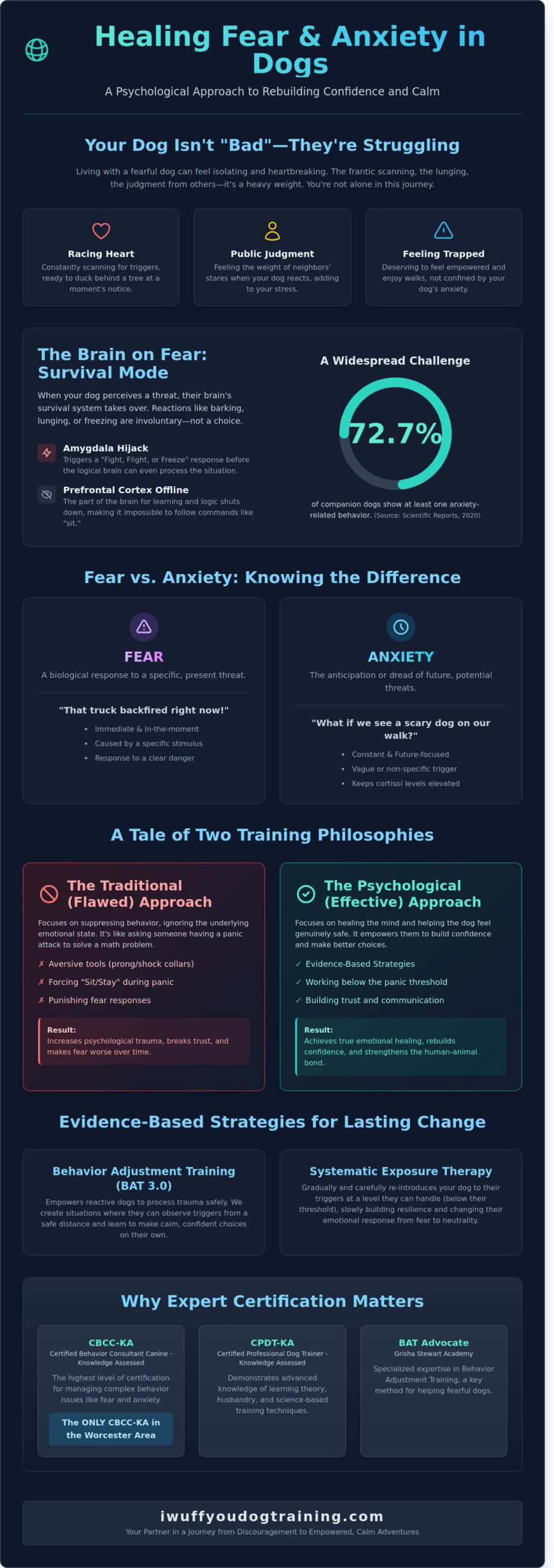
When your dog perceives a threat, their brain’s limbic system takes over. The amygdala triggers a “fight, flight, or freeze” response before the cognitive brain can even process the situation. Understanding the psychology of dog behavior helps us realize that these reactions are involuntary. It is an internal emotional state, not a choice. A 2020 study published in Scientific Reports found that 72.7% of companion dogs show at least one anxiety-related behavior. You aren’t alone in this journey, and your dog deserves a compassionate path toward healing.
Fear vs. Anxiety: Knowing the Difference
Fear is a biological response to a specific, present stimulus. It is the sound of a heavy truck backfiring in downtown Worcester or a sudden umbrella opening. Anxiety is the “what if” in your dog’s mind. It is the anticipation of future threats that haven’t happened yet. Chronic anxiety keeps a dog’s cortisol levels elevated, which can lead to long-term health issues and a decreased lifespan. We use cognitive training to help your dog shift from constant vigilance to a state of true safety.
The Spectrum of Reactivity in Central MA Dogs
Reactivity is often just a mask for deep-seated fear. In the urban-suburban mix of Worcester and Holden, triggers are everywhere. It might be a delivery driver or a barking dog behind a fence. I want to empower you: reactivity shouldn’t keep you trapped at home. You can take your dog out in public again! By using professional guidance and evidence-based methods like exposure therapy, we move from managing the lunging to healing the root cause. Through reactive dog training, we help your dog achieve a calm, relaxed state. Let’s prevent the heartbreak of isolation and start the healing process today!
Beyond Obedience: Why Traditional Training Fails Fearful Dogs
Traditional obedience training often treats dogs like biological machines that just need the right input to produce the correct output. If your furry baby is trembling or lunging at a passing car, asking them to “sit” is like asking a person in the middle of a panic attack to solve a complex calculus equation. It’s physically and neurologically impossible. When a dog is in a state of terror, their prefrontal cortex, the part of the brain responsible for learning and logic, effectively shuts down. The amygdala takes over, triggering a survival response that overrides any “stay” command you’ve practiced in your living room.
Using aversive methods like prong or shock collars in these moments doesn’t just fail; it backfires. A 2020 study published in Scientific Reports found that roughly 72.7 percent of dogs exhibit at least one anxiety-related behavior. Layering physical pain on top of that existing fear creates deep psychological trauma. As the only Certified Behavior Consultant Canine-Knowledge Assessed (CBCC-KA) in the Worcester area, I’ve seen how these “quick fix” tools suppress the outward behavior while the internal pressure cooker of anxiety continues to boil. We need a fear and anxiety in dogs a psychological approach that prioritizes the dog’s mental health over simple compliance.
Understanding “thresholds” is the first step toward healing. Your dog isn’t being “stubborn” or “disobedient” when they stop listening. They are over-aroused and biologically incapable of processing your voice. My work as a CPDT-KA and a Grisha Stewart Academy BAT Advocate focuses on keeping your dog below that threshold of panic so they can actually learn to feel safe again.
The Problem with Suppressing Emotions
A quiet dog is not always a calm dog. When we punish a growl or a bark, we often force dogs into “learned helplessness.” This is a dangerous state where the dog stops reacting because they’ve given up hope, not because they feel better. We strictly avoid “flooding,” which involves forcing a dog to stay in the presence of their trigger until they stop reacting. This is why we focus on building a foundation of safety in our innovative dog training. We want your dog to feel secure enough to relax, not just too scared to move.
Cognitive Training: Engaging the Dog’s Brain
To truly help a fearful dog, we must move from a command-based relationship to a partnership. This is the heart of cognitive training. Instead of telling your dog what to do, we teach them how to make choices and gain agency in their environment. By engaging in problem-solving games and choice-based exercises, your dog learns to process information differently. This shift in a fear and anxiety in dogs a psychological approach helps build genuine canine confidence. If you’re ready to see your dog’s confidence grow, let’s explore our reactive dog training options together.
The Role of a Certified Behavior Consultant in Worcester
Many dog parents in Central Massachusetts feel trapped inside their homes because their dog lunges or barks at every passing car. It’s heartbreaking to watch your furry baby live in a state of constant hyper-vigilance. You want to enjoy a stroll through Elm Park, but instead, you’re hiding behind parked cars to avoid a meltdown. This is where the distinction between a standard trainer and a behavior consultant becomes life-changing. While a traditional trainer might focus on teaching a “sit” or “stay,” a consultant dives into the “why” behind the panic.
Taking a fear and anxiety in dogs a psychological approach means looking at the brain, not just the leash. We focus on shifting the dog’s emotional baseline from “terrified” to “calm.” This specialized work requires a deep understanding of canine psychology that goes far beyond basic obedience. It empowers discouraged parents to stop managing their lives around their dog’s triggers and start living again. We’ve got their paw, and yours too!
- Expertise: Cristina Galanek is currently the only CBCC-KA certified trainer in the Worcester area.
- Science-Based: Every plan uses evidence-based methods like exposure therapy to help dogs process trauma.
- Compassion: We replace “alpha” rhetoric with empathy and cognitive training.
What is a CBCC-KA and Why Is It Rare?
The Certified Behavior Consultant Canine-Knowledge Assessed (CBCC-KA) designation is the “gold standard” in the industry. It isn’t a weekend certification. It requires at least 300 hours of experience specifically in canine behavior modification and a rigorous examination of ethology and learning theory. Because these standards are so high, finding a consultant with this level of expertise is rare. This advanced knowledge allows us to apply a fear and anxiety in dogs a psychological approach that treats the root cause of reactivity rather than just suppressing the symptoms. Your furry beloved companions deserve a professional who understands the complex science of their emotions.
A Trusted Advocate for the Worcester Community
Living in towns like Holden or Shrewsbury provides a beautiful backdrop for life with a dog, but the local environment can be overwhelming for a fearful pup. We provide private in-home dog training to ensure your dog learns in the environment where they feel safest. Our goal is to create a tailored behavior plan that fits your specific lifestyle in Central MA. We believe reactivity shouldn’t keep you locked away. With the right professional guidance and the support of a BAT Advocate from the Grisha Stewart Academy, you can find the confidence to take your dog out in public again. Let’s turn those stressful walks into moments of connection and joy!
Evidence-Based Strategies: BAT 3.0 and Exposure Therapy
Fear isn’t a choice your dog makes; it’s a physiological response that takes over their entire body. When we address fear and anxiety in dogs a psychological approach is essential because it moves us beyond simple obedience. As the only Certified Behavior Consultant Canine-Knowledge Assessed (CBCC-KA) in the Worcester area, I focus on the internal emotional state of your furry baby rather than just their outward “naughty” behaviors. We don’t just want a dog who stays quiet; we want a dog who feels safe.
My credentials as a CPDT-KA and a Grisha Stewart Academy BAT Advocate allow me to bring specialized, evidence-based tools to your doorstep. These aren’t “old-school” methods that suppress your dog’s feelings. Instead, we use modern science to help your dog regain their confidence and peace of mind.
The Power of BAT 3.0
Developed by Grisha Stewart, Behavior Adjustment Training (BAT) gives your dog a voice in a world that often ignores their needs. This method is a vital part of our reactive dog training because it uses “functional rewards.” If your dog is scared of another dog at Elm Park in Worcester, the reward they want isn’t always a treat; it’s often more space. BAT 3.0 teaches your dog that they can communicate their need for distance through calm body language instead of lunging or barking.
- Leash Handling: We use long lines to allow natural movement, reducing the frustration of a tight leash.
- Social Distance: We find the “sweet spot” where your dog sees the trigger but doesn’t feel the need to react.
- Agency: Your dog learns they can “choose” to walk away, which builds massive amounts of self-regulation.
Exposure Therapy Done Right
Helping a dog process trauma requires a delicate balance of desensitization and counter-conditioning. Desensitization involves exposing your dog to a very low level of what scares them, like a distant bicycle at Trout Brook in Holden. We combine this with counter-conditioning, where we pair that “scary” thing with something your dog loves. This creates a psychological “one-two punch” that changes the brain’s emotional response from “danger” to “good things happen.”
We focus on “micro-exposures” that never push your dog over their threshold. If your dog’s heart rate spikes or they stop taking treats, we’ve gone too far. The goal is genuine relaxation. By using cognitive training, we help your dog process their environment thoughtfully rather than reacting impulsively. This transition from a state of high alert to emotional wellness is the greatest gift you can give your furry beloved companion.
Reactivity doesn’t have to mean you’re trapped at home. With the right psychological tools, you can enjoy public spaces again with a dog who feels secure in your partnership.
Helping Your Dog Thrive in Worcester, Holden, and Beyond
Living in Central Massachusetts with a fearful dog can feel isolating. Whether you’re walking near Elm Park or trying to enjoy a quiet street in Holden, the world feels full of potential triggers. However, utilizing fear and anxiety in dogs a psychological approach allows you to reclaim your peace of mind. It isn’t just about fixing a behavior; it’s about understanding the complex emotional landscape of your furry beloved companion. We believe every dog parent deserves to feel confident when they clip on that leash and head out the door.
Handling Worcester’s Real-World Challenges
Worcester and Holden have clear leash laws that act as a vital safety net for your anxious dog. These laws mean you have the legal right to space in public areas. If you encounter an off-leash dog in a neighborhood where they should be secured, it’s okay to advocate for your dog’s needs. For quieter outings, we recommend the less-traveled paths of Rutland State Park or the open spaces in Holden where the sightlines are clear. Having a 360-degree view of your surroundings helps you manage your dog’s threshold before they become overwhelmed.
Our approach is grounded in the expertise of the only Certified Behavior Consultant Canine-Knowledge Assessed (CBCC-KA) in the Worcester area. This distinction is vital because it means your trainer has met rigorous, science-based standards for complex behavioral intervention. By using our dog training methods, you’ll learn how to handle these real-world Central MA stressors without the panic. We focus on cognitive training and impulse control to help your dog make better choices when they feel pressured.
Your Journey to a Calm and Relaxed Dog
Healing takes time, and setting realistic goals is the first step toward success. As a CPDT-KA and a Grisha Stewart Academy BAT Advocate, I focus on changing how your dog feels, not just how they act. We use evidence-based techniques like exposure therapy to gradually build your dog’s confidence in a controlled, safe manner. This psychological approach moves beyond basic obedience. We’re looking for a mental shift where your dog no longer feels the need to react out of fear or trauma.
You aren’t just an owner; you’re a compassionate dog parent. Reactivity shouldn’t keep you trapped inside or make you feel ashamed of your dog’s struggles. With the right professional guidance and a focus on fear and anxiety in dogs a psychological approach, your dog can reach a state of calm and relaxation that once felt impossible. Ready to help your dog? Book a consultation with Worcester’s behavior expert today. We’ve got their paw!
Empower Your Furry Baby to Navigate Worcester with Confidence
Your dog isn’t being “bad” when they bark or lunge; they’re simply asking for help. By choosing fear and anxiety in dogs a psychological approach, you’re looking past the behavior to heal the underlying emotion. Traditional obedience often masks the problem, but evidence-based methods like BAT 3.0 and exposure therapy create lasting peace of mind. You don’t have to stay hidden in your house. With the right support, your furry beloved companion can enjoy the trails in Holden or the parks in Worcester again.
You deserve the expertise of a specialist who understands the complex science of the canine mind. As the 1 and only Certified Behavior Consultant Canine-Knowledge Assessed (CBCC-KA) in the Worcester area, I provide a level of care that goes beyond standard training. My qualifications as a CPDT-KA and a Grisha Stewart Academy BAT Advocate ensure your dog receives the most modern, compassionate guidance available. Let’s transform those stressful walks into moments of joy. We’ve got their paw!
Schedule Your Private Behavior Consultation in Worcester Today
Frequently Asked Questions
Is there a difference between a fearful dog and a reactive dog?
Reactivity is an outward behavioral response, while fear is the internal emotional state driving it. A fearful dog might cower or hide, but a reactive dog uses distance-increasing behaviors like barking or lunging to make the scary thing go away. At I Wuff You, we address both by looking at the brain first. Understanding the difference helps us apply the right psychological approach to ensure your furry beloved companion feels safe and heard.
Can an older dog in Worcester overcome long-term anxiety?
Yes, older dogs can absolutely find relief from long-term anxiety through targeted cognitive training. Neuroplasticity exists throughout a dog’s life, meaning their brain can form new, calmer pathways even after 10 years of fearful habits. We use science-based methods to rewire these responses. Whether you’re in the West Side or Burncoat, your senior dog deserves a retirement free from the heavy burden of constant worry and stress. We’ve got their paw!
What should I do if my dog has a panic attack during a walk in Holden?
If your dog has a panic attack, immediately increase the distance between them and the trigger to lower their physiological arousal. Use a flight response safely by performing a calm U-turn and heading back to your car or a quiet side street. Don’t ask for sits or stays when their brain is in survival mode. Once home, give them 72 hours of cortisol reset time to let their stress hormones return to baseline levels.
Why is Cristina Galanek the best choice for fearful dogs in Central MA?
Cristina Galanek is the only Certified Behavior Consultant Canine-Knowledge Assessed (CBCC-KA) in the Worcester area, making her uniquely qualified for complex cases. She also holds CPDT-KA certification and is a recognized Grisha Stewart Academy BAT Advocate. This means she isn’t just a trainer; she’s a behavior specialist. Her expertise in fear and anxiety in dogs a psychological approach ensures your dog receives the most advanced, compassionate care available in Central MA.
How long does it take to see results with a psychological approach to dog training?
Most dog parents observe a noticeable shift in their dog’s recovery time within the first 21 to 30 days of consistent training. However, deep-seated psychological change is a journey rather than a sprint. While we can’t fix trauma overnight, our BAT 3.0 techniques provide you with immediate tools to manage daily life. You’ll see your dog start to make better choices independently as their internal confidence grows through our structured, empathetic support.
Is exposure therapy safe for dogs with a history of trauma?
Exposure therapy is safe and highly effective when conducted as systematic desensitization under the guidance of a professional like a CBCC-KA. We never flood a dog by forcing them to face their fears head-on. Instead, we use controlled, low-level exposures that stay below the dog’s emotional threshold. This careful process allows 100 percent of the focus to remain on your dog’s comfort, ensuring they never feel overwhelmed or re-traumatized during the session.
Can I train my anxious dog even if I live in a busy part of Worcester?
You can absolutely train an anxious dog in a busy urban environment by utilizing quiet windows and specific neighborhood pockets. Living near Shrewsbury Street or Kelley Square doesn’t mean your dog is destined for stress. We start training in your home where it’s safe, then gradually move to the real world. Our goal is to empower you so that a busy sidewalk becomes a manageable classroom rather than a source of heartbreak for you both.
What are the first signs that my dog is ‘over threshold’?
The first signs your dog is over threshold include dilated pupils, closed mouths, or sudden scanning of the environment. You might notice their ears pin back or their body stiffen as they stop taking treats. When 80 percent of their focus is on the trigger, they’ve lost the ability to learn. Recognizing these subtle shifts early allows us to intervene before a full emotional meltdown occurs, keeping the human-canine bond strong and healthy.