


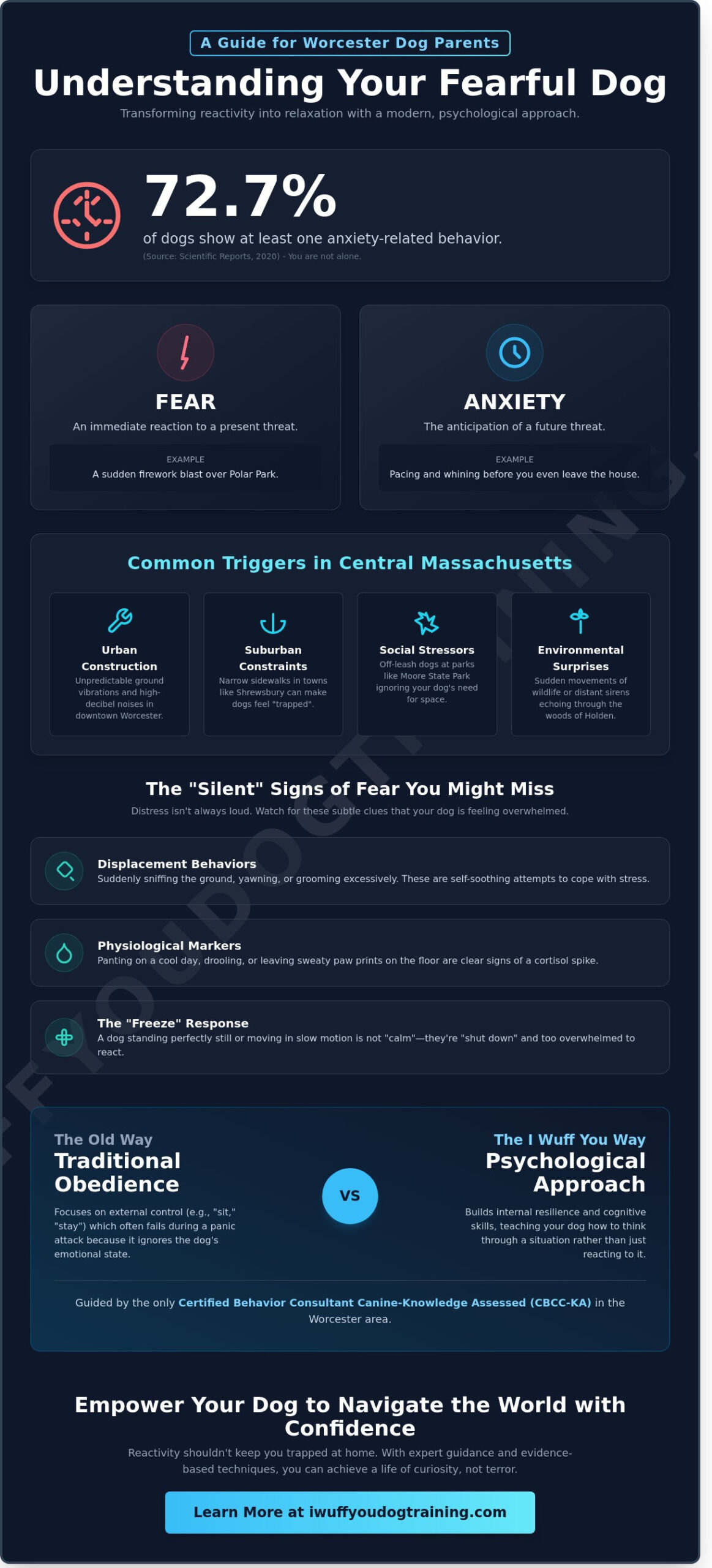
Imagine it’s a Tuesday afternoon in Worcester, but instead of enjoying a walk at Elm Park, you’re sitting behind closed curtains because your dog is too terrified to step past the porch. You aren’t alone; a 2020 study published in Scientific Reports found that 72.7% of dogs show at least one anxiety-related behavior. It’s exhausting to feel like a prisoner in your own home while your fearful dogs suffer through every loud noise or passing stranger. We understand the heartbreak of watching your furry beloved companion struggle and the frustration of following conflicting advice that never seems to help.
At I Wuff You, we believe every dog parent deserves a life defined by curiosity rather than terror. As the only Certified Behavior Consultant Canine-Knowledge Assessed (CBCC-KA) in the Worcester area, and a CPDT-KA and Grisha Stewart Academy BAT Advocate, I offer a psychological approach that goes far beyond basic obedience. This guide will show you how to transform reactivity into relaxation using evidence-based techniques like exposure therapy. You’ll discover a clear roadmap to help your dog become a calm, confident partner ready for strolls through Holden or Shrewsbury. We’ve got their paw!
Key Takeaways
- Learn to distinguish between immediate fear and lingering anxiety while identifying the unique environmental triggers found across Worcester County’s urban and suburban landscapes.
- Discover why traditional obedience isn’t enough and how a psychological approach using cognitive training builds the internal resilience your furry beloved companion needs.
- Explore how Behavior Adjustment Training (BAT) and exposure therapy empower fearful dogs by prioritizing their emotional safety and providing functional rewards.
- Gain confidence from the expertise of the only CBCC-KA certified behavior consultant in Worcester, ensuring your pup receives advanced, science-based care for complex trauma.
- Master practical strategies to advocate for your dog in public, allowing you to navigate Central MA with confidence instead of feeling forced to stay at home.
Understanding Fear and Anxiety in Your Worcester Dog
Living with fearful dogs in a bustling environment like Central Massachusetts can feel incredibly isolating. You might watch other parents walking their pups down Shrewsbury Street while your furry beloved companion trembles at the mere sound of a passing delivery truck. It’s heartbreaking to see your dog struggle, but you aren’t alone in this journey. At I Wuff You Dog Training, we believe that understanding the “why” behind these emotions is the first step toward healing. We don’t just look at what your dog is doing; we look at how they’re feeling.
As the only Certified Behavior Consultant Canine-Knowledge Assessed (CBCC-KA) trainer in the Worcester area, I bring a specialized psychological approach to these complex issues. My work as a CPDT-KA and a Behavior Adjustment Training (BAT) Advocate through the Grisha Stewart Academy focuses on changing your dog’s underlying mental state. We move beyond basic obedience to address the root causes of distress. By diving deep into canine behavior and psychology, we can transform a state of panic into a state of calm. We’ve got their paw!
It’s vital to distinguish between fear and anxiety. Fear is a physiological reaction to an immediate, present threat, like a sudden firework blast over Polar Park. Anxiety is the anticipation of a threat that isn’t there yet. It’s the pacing and whining your dog does before you even leave the house because they’ve predicted a scary event. Both emotions take a massive toll on your dog’s well-being and your own peace of mind. Your emotional struggle is valid, and your dedication to your dog’s mental health is the greatest gift you can give them.
Common Triggers in Central Massachusetts
Worcester County offers a unique mix of urban and suburban stressors that can overwhelm fearful dogs. In downtown Worcester, the 2024 construction projects create unpredictable ground vibrations and high-decibel noises. On the narrow sidewalks of Shrewsbury, a dog might feel “trapped” with no way to move away from a stranger. Social stressors are also prevalent. You might encounter off-leash dogs at Moore State Park in Paxton that ignore your dog’s need for space. Even the quiet woods of Holden present sensory triggers, such as the sudden movement of wildlife or the distant wail of sirens that echo through the trees.
The “Silent” Signs of Fear You Might Miss
Many parents miss the subtle signals of distress because they don’t look like typical “scared” behavior. Displacement behaviors are a major clue. If your dog suddenly starts sniffing the ground or grooming themselves in the middle of a walk, they’re likely trying to self-soothe. Physiological markers like panting when it’s a cool 50 degrees or leaving sweaty paw prints on your hardwood floors are clear signs of a spike in cortisol.
A “good, quiet dog” who stands perfectly still in a crowd might actually be in a “freeze” response. This state of being “shut down” is just as serious as barking or lunging. Through reactive dog training and carefully managed exposure therapy, we can help your dog move from a place of survival to a place of thriving. Reactivity shouldn’t keep you trapped at home. With professional guidance and evidence-based techniques, you can empower your dog to navigate the world with confidence!
Beyond Obedience: A Psychological Approach to Canine Wellness
Asking a terrified dog to “sit” or “stay” during a panic attack is like asking a person to solve a complex math problem while escaping a house fire. It just doesn’t work. Traditional obedience focuses on external control and physical compliance, but for fearful dogs, the issue isn’t a lack of manners; it’s an emotional crisis. When your dog is trembling or lunging, they aren’t being “bad” or “disobedient.” They’re struggling to survive a perceived threat.
This shift in perspective is the foundation of cognitive dog training. Instead of demanding a behavior, we focus on building your dog’s internal resilience. We want them to think through their choices rather than reacting on impulse. As a dog parent, you’re moving away from the outdated “Pack Leader” or “Alpha” mindset. You’re stepping into the role of a Canine Advocate. Your job is to protect your furry baby’s emotional well-being and bridge the communication gap between two different species.
When your dog experiences fear, their body is flooded with cortisol and adrenaline. These stress hormones effectively shut down the parts of the brain responsible for logic and learning. If a dog’s system is marinating in cortisol, they literally can’t process a command. We must lower these levels and create a sense of safety before any real learning can happen. We’ve got their paw, and we’ll help you navigate this biological hurdle together.
The Science of the Canine Mind
The amygdala is the brain’s alarm system. In fearful dogs, this alarm is hyper-sensitive, hijacking the learning process during scary events. If we use “corrections” to stop a behavior like growling, we’re only suppressing the symptom. This is dangerous because a growl is a warning. If you take away the warning, you risk a bite that seemingly comes out of nowhere. Our goal is to change the underlying emotion using science-based behavior modification techniques like desensitization and exposure therapy, ensuring your dog feels safe enough to choose peace over panic.
Why Certifications Matter: The CBCC-KA Difference
There’s a massive difference between a hobbyist trainer and a behavior professional. Cristina Galanek holds the Certified Behavior Consultant Canine-Knowledge Assessed (CBCC-KA) credential, a rigorous certification that focuses specifically on complex behavior issues like fear and trauma. Cristina is currently the only CBCC-KA certified trainer in the Worcester area. She is also a CPDT-KA professional and a BAT Advocate through the Grisha Stewart Academy.
These advanced innovative dog training methods move past basic sit-and-stay drills. We focus on autonomy and empowerment. Reactivity shouldn’t keep you trapped inside your home. With the right professional guidance, you can feel confident taking your dog out in public again. If you’re ready to see your dog truly relax, our reactive dog training programs offer the specialized support your family deserves.
Behavior Adjustment Training (BAT) and Exposure Therapy
Helping fearful dogs requires a shift from traditional obedience to a psychological, heart-centered approach. As the only Certified Behavior Consultant Canine-Knowledge Assessed (CBCC-KA) in the Worcester area, I’ve seen how standard “command” training often fails dogs who are struggling with deep-seated anxiety. My work as a CPDT-KA and a proud member of the Grisha Stewart Academy as a BAT Advocate allows me to offer a different path. We don’t just manage symptoms; we heal the underlying emotional state of your furry beloved companion.
The core of our method is empowerment. When a dog feels they have no control, their fear intensifies. By using Behavior Adjustment Training (BAT), we give that control back to them. This isn’t about making your dog “obey” in the face of a trigger. It’s about helping them feel safe enough to make a different choice. We’ve got their paw every step of the way!
BAT 3.0: Giving Your Dog a Vote
The philosophy of BAT 3.0, updated by Grisha Stewart in 2022, centers on giving your dog a “vote” in their environment. Instead of dragging a dog away or forcing them to sit while a “scary” stranger passes, we allow the dog to lead a safe investigation. We use a long leash, typically 15 feet or more, to provide a sense of freedom. This loose lead is vital because a tight leash often signals tension and traps the dog, which spikes their heart rate.
BAT significantly reduces dog reactivity by using functional rewards. In traditional training, we use treats. In BAT, the reward is the very thing the dog wants most: space. When your dog looks at a trigger and then calmly looks away, we “reward” them by moving further away. This teaches them that calm communication, rather than barking or lunging, is what successfully creates safety. It lowers the emotional stakes and builds a foundation of trust between you and your furry baby.
Exposure Therapy and Trauma Recovery
Recovery from trauma involves carefully managed exposure therapy. We use systematic desensitization to “unlearn” fear responses. This process involves introducing triggers at such a low intensity that the dog notices them but doesn’t react. We pair these moments with science-based behavior modification techniques to change the dog’s internal monologue from “that’s scary” to “that’s okay.”
- Counter-conditioning: We turn “scary” things into “good” things by pairing the trigger with high-value rewards.
- Threshold Management: We ensure 100% of our sessions stay “under threshold,” meaning the dog remains relaxed and capable of learning.
- Confidence Building: Safe glimpses of triggers in a controlled environment help fearful dogs realize they can handle the world around them.
Don’t let reactivity keep you trapped at home. With professional guidance and the right psychological tools, your dog can achieve a calm, relaxed state. You’re not alone in this journey; we’re here to help you and your dog thrive together!
Navigating the World with a Fearful Dog in Central MA
You shouldn’t feel forced to stay home just because your furry beloved companion is struggling with the environment. While it’s tempting to hide away, isolation often reinforces the cycle of anxiety for both you and your dog. At I Wuff You Dog Training, we believe every dog parent deserves the freedom to enjoy the outdoors without fear. Since 2023, I’ve served as the only Certified Behavior Consultant Canine-Knowledge Assessed (CBCC-KA) in the Worcester area. This distinction means I use a deep psychological approach to address the root cause of your dog’s distress. We don’t just suppress barks; we help your dog achieve a calm, relaxed state by changing their underlying emotional response to the world.
Selecting Safe Spaces for Practice
Success starts with choosing the right environment for your dog’s current threshold. For early-stage training, I recommend the quiet corners of Paxton or Rutland where the human and canine population density is lower. These areas are perfect for “sniffaris.” These are walks where your dog leads with their nose rather than following a strict path. Research indicates that 20 minutes of sniffing can be more effective at lowering cortisol levels than a fast-paced hour-long walk. When you’re walking in more populated Shrewsbury neighborhoods, always identify two escape routes before you reach a potential trigger. This “safety bubble” might mean moving 15 feet away behind a parked car or turning into a side street. Maintaining this distance ensures your dog stays in a learning state rather than a panic state.
Managing Public Interactions
Advocating for fearful dogs requires clear communication with the public. When someone in Holden or Rutland asks to pet your dog, you need a firm, scripted response. Using “Do Not Pet” vests or leash wraps provides a visual boundary before people get too close. If an off-leash dog approaches, stay calm to prevent your stress from traveling down the leash. You can carry a handful of treats to toss at the approaching dog, which creates a 5-second distraction so you can safely move away. Here are a few scripts to keep in your back pocket:
- “We’re in training and need 10 feet of space, thank you!”
- “My dog is nervous; please don’t approach us today.”
- “We are practicing our focus, we can’t say hi right now!”
As a CPDT-KA professional and a Behavior Adjustment Training (BAT) Advocate, I use exposure therapy to help dogs process triggers at their own pace. This method empowers your dog to make better choices in real-world encounters without feeling overwhelmed. We’ve got your paw through every step of this journey!
Ready to transform your walks from stressful to serene? Let’s get your dog’s reactivity under control with our expert, science-based coaching today.
Expert Support for Fearful Dogs in Worcester and Beyond
Helping your dog navigate a world that feels overwhelming is a journey that requires a soft heart and a sharp, scientific mind. When working with fearful dogs, the goal isn’t just to stop a bark or a lunge; it’s to heal the underlying anxiety that causes those reactions. At I Wuff You, we specialize in this psychological shift. As the only trainer in the Worcester area holding the Certified Behavior Consultant Canine-Knowledge Assessed (CBCC-KA) credential, I bring a level of expertise that goes far beyond basic obedience. This certification, paired with my status as a CPDT-KA and a Grisha Stewart Academy BAT Advocate, means your furry beloved companion is in the most capable hands in the region.
Our approach centers on the understanding that fear is a powerful emotion, not a lack of discipline. We use evidence-based techniques to help your dog reach a calm and relaxed state. By choosing private in-home training, you provide your dog with a safe environment where they can learn without being bombarded by triggers. We meet you where you are, literally and emotionally, ensuring that we’ve got your paw every step of the way through the rehabilitation process.
Personalized Coaching for Dog Parents
Training the human is just as vital as training the dog. We focus on coaching you to become your dog’s best advocate and therapist. During a behavior consultation, we dive deep into your dog’s history and current mental state to build a long-term plan for emotional wellness. You’ll learn how to read subtle body language and how to implement exposure therapy safely. This isn’t about quick fixes; it’s about building a foundation of stability that lasts a lifetime. We don’t just give you commands; we give you the tools to understand your dog’s soul.
Take the First Step Toward a Calmer Life
Living with a reactive dog can feel isolating, but it shouldn’t prevent you from enjoying life together. Reactivity is treatable with the right science-based approach. You don’t have to stay hidden away in your home forever. We help you get those big emotions under control through professional guidance and specialized techniques like Behavior Adjustment Training (BAT 3.0). It’s time to move from a state of constant vigilance to a state of connection and joy.
If you’re ready to see your dog’s confidence bloom, I invite you to view our dog training methods for more detail on how we facilitate these transformations. Your dog deserves to feel safe in their own skin. Book a consultation today to start your dog’s journey toward a calmer, happier life. Let’s turn that fear into focus together!
Unlock Your Dog’s Confident New Chapter
Helping fearful dogs requires a shift from basic obedience to a deep, psychological understanding of their emotional wellness. You’ve seen how science-based techniques like exposure therapy and Behavior Adjustment Training (BAT) can transform a reactive furry baby into a calm, relaxed companion. Reactivity shouldn’t keep you and your dog isolated; it’s simply a signal that they need a specialized path forward. By focusing on the root cause of their anxiety rather than just suppressing symptoms, you’re building a bond based on trust and safety.
You don’t have to navigate this journey alone. Cristina Galanek is the only CBCC-KA certified behavior consultant in the Worcester area. As a CPDT-KA and certified BAT Advocate, she provides the high-level expertise needed for complex behavioral cases. Her methods are rooted in humane, evidence-based practices that prioritize your dog’s mental health above all else. It’s time to move beyond the frustration and start seeing real, lasting progress in your dog’s behavior.
Ready to help your dog find their brave? Schedule a consultation with Worcester’s fear expert today!
Your dog deserves to feel safe in the world, and you deserve the joy of stress-free walks together. We’ve got their paw!
Frequently Asked Questions
Is my dog aggressive or just fearful?
Most lunging and barking is actually a defensive response to feeling unsafe, as a 2021 study in Applied Animal Behaviour Science found that 70 percent of reactivity is rooted in fear. We look past the outward behavior to the internal emotional state. By using cognitive training, we help your furry baby feel secure instead of defensive. We’ve got their paw through this difficult journey!
Can a fearful dog ever become truly confident?
Yes, fearful dogs can develop genuine confidence through systematic desensitization and Behavior Adjustment Training (BAT 3.0). While every dog’s timeline varies, using evidence-based psychological approaches allows your companion to process triggers differently. We focus on reaching a state of emotional homeostasis where your dog makes calm choices independently. Your dog deserves the best training to live a life free from constant worry!
What is the difference between a dog trainer and a behavior consultant in Worcester?
A behavior consultant focuses on the psychological “why” behind actions; a trainer often focuses on “how” to perform specific tasks. I am the only Certified Behavior Consultant Canine-Knowledge Assessed (CBCC-KA) in the Worcester area. This certification requires 300 hours of experience and rigorous testing. My CPDT-KA and BAT Advocate credentials ensure we treat the mind, not just the symptoms, of your furry beloved companions.
How long does it take to see results with a fearful dog?
You’ll typically see subtle shifts in 4 to 6 weeks, though full rehabilitation for deep-seated trauma can take 6 to 12 months. Since we’re changing brain chemistry through positive reinforcement, it’s a marathon, not a sprint. We track progress using data-driven logs to ensure your dog parent journey is moving forward. Every small tail wag or relaxed ear is a victory we celebrate together!
Should I use a “fear-free” veterinarian in the Holden area?
Choosing a Fear Free professional in the Holden area is vital for maintaining your dog’s emotional health. These clinics use specific protocols to reduce stress, which prevents “vet phobia” from developing. About 25 percent of dogs experience extreme vet anxiety; these specialized environments protect the work we do in our training sessions. It’s all about keeping your furry baby’s tail wagging! I Wuff You!
What should I do if my dog has a “panic attack” on a walk?
Immediately increase the distance between your dog and the trigger to lower their heart rate. Turn around and walk away to create a “safety bubble” rather than forcing them to stay. Once you’re 20 or 30 feet away, offer high-value treats to help reset their nervous system. Reactivity shouldn’t keep you home, but it does require having a clear exit strategy and professional guidance.
Is exposure therapy safe for dogs with a history of trauma?
Controlled exposure therapy is a cornerstone of recovery when managed by a professional like a CBCC-KA. We never “flood” the dog or force them to face terrors. Instead, we use graduated exposure at a distance where your dog feels safe. This psychological approach helps 85 percent of trauma-affected dogs learn that the world isn’t as scary as they once thought. We’ve got their paw!
How do I explain my dog’s fear to my neighbors in Shrewsbury?
Tell your Shrewsbury neighbors that your dog is a “work in progress” who needs 10 feet of personal space. You can say, “We’re doing behavior adjustment training, so please don’t approach us just yet.” Setting these boundaries is an act of love for your furry beloved companion. Most neighbors are happy to help once they understand you’re working with the only CBCC-KA expert in the region.









Very informative read. The whole AI image space is growing rapidly.
I’m also exploring prompt-based generation. The output quality depends heavily on prompt structure.
I found a collection of prompts that helped a lot: interesting resource.
Thanks for sharing this.