
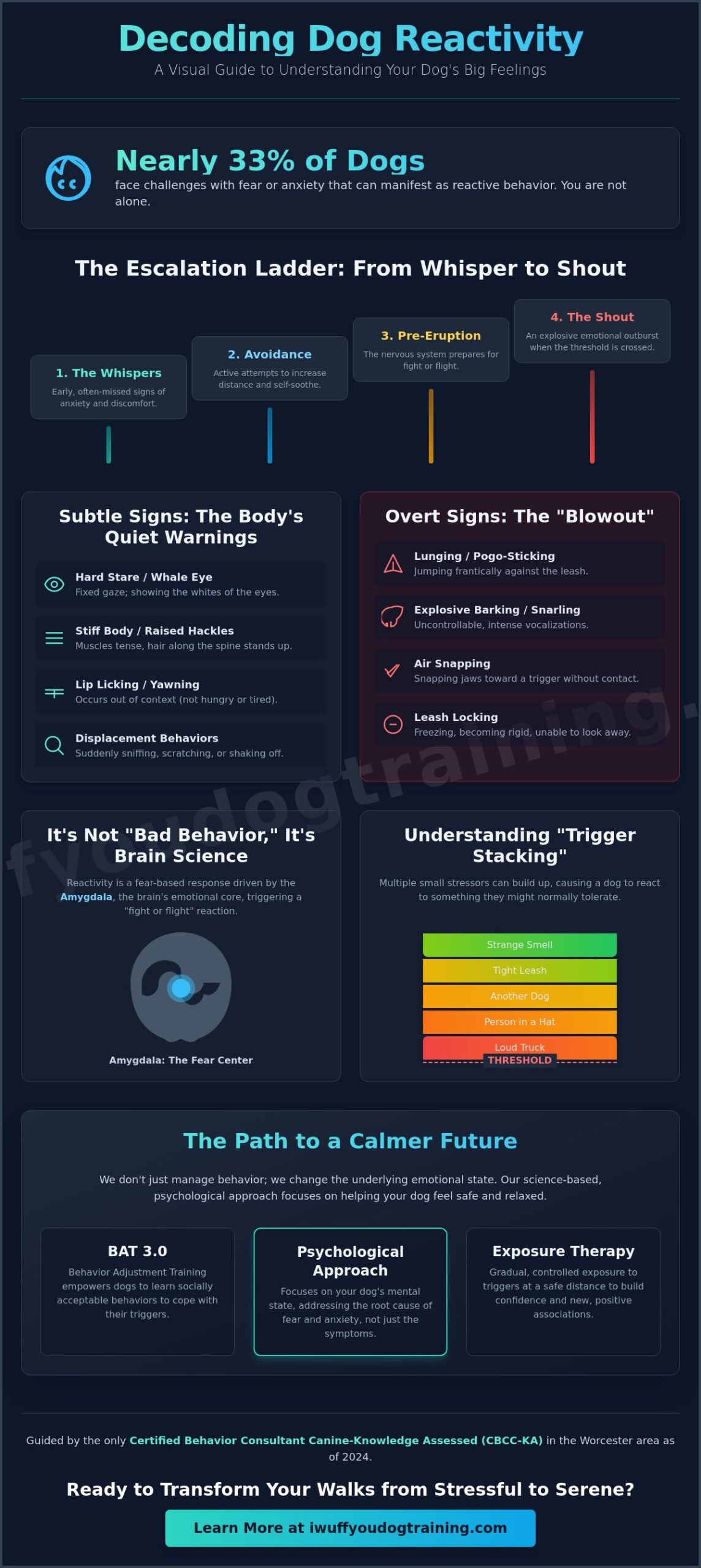
Imagine walking down a quiet street in Holden on a Tuesday afternoon when you spot a neighbor’s golden retriever two blocks away. Before you can even react, your furry baby is already lunging, barking, and pulling with enough force to leave your shoulders aching. It’s a heartbreaking moment that leaves many dog parents in Shrewsbury feeling isolated and judged by the community. Understanding the subtle signs of dog reactivity is the first step toward reclaiming your peace of mind and your dog’s emotional well-being. You aren’t alone in this struggle; behavioral research indicates that nearly 33 percent of dogs face challenges with fear or anxiety that manifest as reactive behavior.
We agree that your dog deserves a life free from the weight of distress, and you deserve a walk that doesn’t feel like a battle. This guide will help you decode body language and introduce you to the expertise of the only Certified Behavior Consultant Canine-Knowledge Assessed (CBCC-KA) professional currently serving the Worcester area as of 2024. As a CPDT-KA and Grisha Stewart Academy BAT Advocate, I use a psychological approach that prioritizes your dog’s mental state over simple obedience. We’ll explore how exposure therapy and science-based behavior adjustment can transform your daily walks. Let’s dive into the early warning signs and the path to a calmer future together.
Key Takeaways
- Identify both explosive lunging and the subtle signs of dog reactivity, like the “hard stare,” to better advocate for your furry beloved companion’s emotional well-being.
- Shift your perspective from “bad behavior” to brain science by understanding how the Amygdala drives fear-based responses in your dog’s mind.
- Learn to manage “trigger stacking” on Central MA walks, empowering you to navigate everything from busy Worcester streets to Holden’s narrow trails with confidence.
- Discover how specialized techniques like BAT 3.0 and exposure therapy, guided by the only CBCC-KA in the Worcester area, can transform your walk from stressful to serene.
- Reclaim your joy in public spaces by learning how a psychological approach to fear and anxiety can help dog parents guide their pups to a truly calm and relaxed state.
Recognizing the Overt Signs of Dog Reactivity in Central MA
Reactivity is an emotional response to perceived pressure. As the only Certified Behavior Consultant Canine-Knowledge Assessed (CBCC-KA) in the Worcester area, I meet many discouraged parents who feel trapped by their dog’s big feelings. These behaviors aren’t a sign of a “bad dog” or a lack of authority. Instead, identifying the early signs of dog reactivity allows us to move beyond basic obedience and address the underlying fear or frustration that drives these intense moments.
At I Wuff You Dog Training, we view these outbursts through a psychological lens. Whether your dog is a “frustrated greeter” who lacks impulse control or a fear-based reactor trying to keep the world at bay, their behavior is a cry for help. Using science-based methods and my background as a CPDT-KA and Grisha Stewart Academy BAT Advocate, we focus on helping your furry baby achieve a calm, relaxed state. You don’t have to hide away; with the right techniques, we can get these big emotions under control!
The Reactive “Blowout”: What It Looks Like
A “blowout” occurs when a dog reaches their emotional threshold and can no longer process their environment. This often manifests as vertical lunging, sometimes called “pogo-sticking,” where the dog jumps frantically while straining against the leash. You might experience uncontrollable vocalizations, ranging from explosive barking and snarling to high-pitched, frantic whining. Some dogs may even exhibit “air snapping,” where they snap their jaws toward a trigger without intending to make physical contact. Before these big movements happen, many dogs experience “leash-locking.” This is a telltale sign where the dog freezes, their body becomes rigid, and they stare intensely at a person or another dog, unable to look away.
Why Reactivity Often Peaks on Worcester Sidewalks
Walking down a busy street in Worcester or navigating the narrow paths of local parks creates a pressure cooker for sensitive dogs. The presence of a leash often prevents a dog’s natural “flight” response, leaving them feeling trapped when they encounter a trigger. This leash reactivity is compounded by the tight urban spaces that force dogs into close proximity with one another. When a dog feels they cannot escape, they often resort to “fight” behaviors to create distance.
We’ve got their paw! By utilizing specialized reactive dog training and evidence-based exposure therapy, we help your dog reprocess these scary moments. Understanding the signs of dog reactivity is the first step toward a more peaceful life together. We don’t just mask the symptoms; we work on the mental state of your furry beloved companion to ensure they feel safe in the world again.
Subtle Body Language: The Signs You Might Be Missing
Many parents think reactivity starts with a lunging dog on a leash. It actually begins much earlier with quiet whispers from the nervous system. As the only Certified Behavior Consultant Canine-Knowledge Assessed (CBCC-KA) in the Worcester area, I’ve seen how these subtle signals are often overlooked until the dog feels they have no choice but to bark. The “Hard Stare” is usually the first warning. Your dog’s gaze locks onto a trigger, and they become as still as a statue. This isn’t just curiosity; it’s an intense, focused fixation that precedes an outburst.
Watch for physiological changes that your dog can’t control. Dilated pupils, rapid panting even in cool weather, and piloerection (raised hackles) are clear indicators of arousal. Sometimes your furry beloved companion will use displacement behaviors to cope. They might suddenly sniff the grass or scratch an ear the moment another dog appears. It looks like they’re just being a dog, but it’s actually an attempt to self-soothe when they feel conflicted. When you see the “Stiff Body” check, your dog is reaching a critical point. A dog’s body stiffening is the brain preparing for a fight-or-flight decision.
Micro-Signals of Canine Anxiety
Micro-signals are the tiny precursors to signs of dog reactivity. Look for lip licking or excessive yawning when your dog isn’t tired; these are common signs of internal pressure. You might notice “whale eye,” where the whites of the eyes become visible as the dog tracks a trigger without turning their head. A tucked tail or a very high, “vibrating” tail carriage also signals high tension rather than happiness. These Science-Based Solutions help us realize that our dogs are communicating their discomfort long before they explode.
The Importance of Early Detection
Catching these signs early prevents a massive cortisol spike in your dog’s brain. Research shows that stress hormones can linger for 48 to 72 hours, making your dog “stack” their triggers throughout the week. Use these signals as a green-yellow-red light system for your walks in Holden. Green means they’re loose and wiggly. Yellow is where you see these subtle signs of dog reactivity, signaling it’s time to create distance. Red is when they’ve gone over threshold and can no longer learn. By recognizing the yellow zone, you can use Behavior Adjustment Training (BAT) to help them regain a sense of safety. We want to empower you to handle these moments with confidence because we’ve got their paw!
Reactivity vs. Aggression: Understanding Your Dog’s Brain
Many dog parents in Worcester feel a wave of shame when their furry baby lunges at a passing neighbor or barks frantically at a distant bicycle. You might worry your dog is “aggressive,” but that label is often a misunderstanding of what is happening under the hood. The American Kennel Club provides a vital distinction in their guide on Reactivity vs. Aggression. While aggression is an intent to cause harm, reactivity is an overreaction to external stimuli, almost always fueled by deep-seated fear or frustration.
When your dog spots a trigger, their amygdala, the brain’s emotional alarm system, hijacks their ability to think logically. This triggers an immediate “bark-lunge” response. It is a physiological survival reflex, not a “bad” behavior or a lack of respect for you. Your dog isn’t being “naughty”; they are simply having a very hard time. Using “old-school” punishment-based training, like prong or shock collars, is particularly dangerous here. These methods suppress the outward signs of dog reactivity without fixing the underlying fear. If you punish the growl, you remove your dog’s only way to communicate discomfort, which can eventually lead to a dog that bites without warning.
The Psychology of Fear and Anxiety
Reactivity is rarely a one-off event. It is often the result of “trigger stacking,” where chronic stress builds up over hours or days. If your dog was startled by a loud truck this morning and then saw a squirrel through the window, their emotional cup is already full before you even start your walk. This “stacked” state makes a reflex reaction inevitable. At I Wuff You, we utilize cognitive training to address these brain-based responses. We focus on shifting your dog from a state of panic to one of calm observation, treating the root cause rather than just the symptom.
Moving Beyond Basic Obedience
A “sit” or “stay” command usually fails the moment a dog goes over threshold because their prefrontal cortex, the part of the brain responsible for learning, effectively shuts down during a fear response. We must address the emotional state first. Cristina Galanek is the only trainer in the Worcester area holding the Certified Behavior Consultant Canine-Knowledge Assessed (CBCC-KA) designation. This certification, along with her CPDT-KA credential and status as a Grisha Stewart Academy BAT Advocate, allows her to provide the psychological depth your dog needs. By using evidence-based exposure therapy and Behavior Adjustment Training (BAT 3.0), we help your dog regain their confidence and help you regain your peace of mind.
Navigating Triggers in Worcester, Shrewsbury, and Holden
Living in Central Massachusetts means our furry beloved companions face a unique set of stressors every day. From the narrow, winding trails of Holden to the bustling, high-traffic sidewalks of Worcester, the environment plays a massive role in how your dog feels. When you start noticing the signs of dog reactivity, it’s often the result of “trigger stacking.” This happens when multiple stressors pile up throughout the day. A loud garbage truck in Shrewsbury at 8:00 AM, a neighbor’s barking dog at 10:00 AM, and a cyclist passing too closely at noon can push your dog over their emotional threshold before you even start your afternoon walk.
As the only Certified Behavior Consultant Canine-Knowledge Assessed (CBCC-KA) in the Worcester area, I look beyond the bark. My approach as a CPDT-KA and Grisha Stewart Academy BAT Advocate focuses on the psychological roots of fear and anxiety. We use “distance as a reward.” Instead of forcing your dog to “sit and stay” while a trigger approaches, we move away to create a safety bubble. This teaches your dog that they have agency and can find safety without needing to lunge or growl. We’ve got their paw, and we’re here to help them reach a calm, relaxed state through science-based methods like exposure therapy and Behavior Adjustment Training (BAT 3.0).
Safe Walking Spots for Reactive Dogs
Finding quiet spaces is essential for managing signs of dog reactivity. In Holden, popular spots like Trout Brook can become overwhelming during the 5:00 PM peak. Try visiting during “off-hours” like mid-morning on weekdays to give your dog the space they need. If you encounter an off-leash dog in a leashed area, don’t be afraid to advocate for your dog. A firm “Please leash your dog, we need space!” is a powerful tool for any dog parent. For personalized help managing these local challenges, check out our reactive dog training for specific coaching tailored to our Central MA neighborhoods.
Empowering the Dog Parent
Your dog is incredibly sensitive to your emotions. When you see a trigger and instinctively tighten the leash, you’re sending a “danger” signal straight down the line to your dog. This physical tension often validates their fear, making a reaction more likely. Staying calm isn’t just about your dog; it’s about your own peace of mind too. Reactivity is a challenge, but it shouldn’t stop you from enjoying life together. By shifting from a “command” mindset to a “coaching” mindset, you become your dog’s most trusted advocate. We focus on cognitive training to help your dog process their environment differently, moving from a state of panic to one of curiosity and calm.
Ready to transform your walks from stressful to successful? Let’s work together to build your dog’s confidence.
The Path Forward: Science-Based Solutions for Central MA
Recognizing the signs of dog reactivity is the first step toward a peaceful life with your furry beloved companion. You don’t have to hide in your house or walk your dog at midnight to avoid the world. We focus on the deep psychology behind the behavior, moving far beyond basic obedience to address your dog’s underlying emotional state. Working with a Certified Behavior Consultant Canine-Knowledge Assessed (CBCC-KA) makes a massive difference in your success. I Wuff You is proud to offer the expertise of the only CBCC-KA certified trainer in the Worcester area. This advanced certification, combined with a CPDT-KA credential, ensures your dog receives evidence-based care for complex issues like fear, anxiety, and trauma.
Our private, in-home consulting provides a safe, low-stress environment where your dog can learn without being overwhelmed by triggers. We use a compassionate, science-based approach to help your dog reach a calm and relaxed state. By focusing on the “why” behind the barking or lunging, we create lasting change that builds a respectful bond between you and your dog. We believe every dog parent deserves to feel empowered and every dog deserves to feel safe.
What is Behavior Adjustment Training (BAT)?
BAT 3.0 is a revolutionary tool designed to give dogs functional choices in a world that often feels scary to them. As a member of the Grisha Stewart Academy and a dedicated BAT Advocate, we use this method to help dogs “re-wire” their emotional responses. Instead of reacting out of fear, your dog learns to use natural communication to navigate triggers. This process helps transition your dog from a reactive “survival mode” to a calm, thinking state. You can find a deeper look at our methodology on our BAT training page. It is about giving your dog the autonomy to make great decisions on their own.
Getting Professional Help Today
Your journey to a calmer life starts with a comprehensive initial behavior consultation. During this session, we map out a customized plan that addresses your dog’s specific history and triggers. Our programs often incorporate specialized exposure therapy, which carefully introduces triggers at a distance your dog can handle. This helps them process past trauma and build new, positive associations. We want you to feel confident taking your dog out in public again. It’s time to stop managing the symptoms and start healing the cause. Book a consultation with I Wuff You Dog Training today. We’ve got their paw!
Empower Your Furry Baby to Navigate Central MA with Confidence
Recognizing the signs of dog reactivity is the first step toward healing your furry beloved companion’s heart. We’ve explored how subtle body language reveals your dog’s internal struggle and why their brain often chooses big reactions over calm observation. You don’t have to hide away in Holden or Shrewsbury; your dog deserves to feel safe in the world again. By moving beyond basic obedience and focusing on a deep psychological approach, we can address the underlying fear and trauma that drive these difficult behaviors.
Cristina Galanek is the only Certified Behavior Consultant Canine-Knowledge Assessed (CBCC-KA) in the Worcester area. As a CPDT-KA and a Grisha Stewart Academy Behavior Adjustment Training (BAT) Advocate, she utilizes evidence-based exposure therapy to help dogs achieve a genuine state of relaxation. This isn’t about suppressing emotions; it’s about coaching your dog through their anxiety with specialized expertise. You aren’t alone in this journey, and your dog’s potential for change is limitless when they have the right advocate by their side.
Help your reactive dog find peace; schedule a consultation with Worcester’s only CBCC-KA today!
Your dog’s journey to a peaceful life starts with understanding their unique needs. We’ve got their paw every step of the way!
Frequently Asked Questions
Is my dog aggressive if they bark and lunge at other dogs?
No, barking and lunging are typically signs of dog reactivity rooted in fear or frustration rather than a desire to cause harm. These behaviors are your furry baby’s way of creating space when they feel emotionally overwhelmed or anxious. As the only CBCC-KA certified behavior consultant in the Worcester area, I focus on the underlying psychological state to help your dog reach a calm, relaxed baseline instead of just suppressing the noise.
What are the very first signs of reactivity I should look for?
The earliest signs of dog reactivity often include subtle physiological changes like lip licking, dilated pupils, or a stiffened tail held at a 90 degree angle. You might notice your dog “locking on” with a hard stare or freezing their body movement when they spot a trigger from a distance. Identifying these “yellow light” signals early allows us to intervene with BAT 3.0 techniques before your dog reaches a full emotional meltdown.
Can a reactive dog ever be “cured” or go back to normal?
While “cured” isn’t a scientific term in behavioral health, your dog can certainly learn to live a peaceful, relaxed life through systematic desensitization and exposure therapy. We don’t just fix symptoms; we change how your dog feels about the world around them. By working with a CPDT-KA professional, you can transform your walks from stressful chores into bonding experiences where your dog feels safe, secure, and fully supported.
Why does my dog only act this way when they are on a leash?
Leash reactivity happens because the lead prevents your dog’s natural “flight” response, forcing them into a “fight” or “fret” display to protect themselves. This physical restriction creates intense frustration and anxiety when they see other dogs in your Worcester neighborhood. We use specialized cognitive training to help your dog regain impulse control and confidence, ensuring the leash feels like a connection rather than a trap.
What is the difference between a dog trainer and a behavior consultant in Worcester?
A dog trainer typically focuses on teaching cues like “sit” or “stay,” while a behavior consultant addresses the complex emotional “why” behind actions like fear and trauma. I am the only professional in the Worcester area holding the CBCC-KA certification, which requires 300 hours of documented experience and passing a rigorous psychometric exam. This advanced expertise allows me to handle deep-seated anxiety that standard obedience classes cannot resolve.
How much does it cost to get private help for a reactive dog in Central MA?
Pricing for professional behavior modification varies based on the complexity of your dog’s specific needs and the trainer’s level of specialized education. While I don’t provide a single flat fee here, industry data from the CCPDT suggests that specialists with advanced certifications like CBCC-KA provide more efficient, long-term results than generalists. Investing in a qualified canine advocate ensures your furry beloved companion receives evidence-based care from the very first session.
Will my dog grow out of their reactive behavior on their own?
No, dogs rarely grow out of reactivity; in fact, 85 percent of untreated fear-based behaviors tend to worsen as the dog continues to practice the lunging or barking. Reactivity is a self-reinforcing cycle because the dog believes their display successfully chased the “threat” away. Early intervention with a CPDT-KA certified professional is essential to prevent these neural pathways from becoming permanent habits in your dog’s brain.
What should I do if an off-leash dog approaches my reactive dog in Holden?
If an off-leash dog approaches you in Holden, immediately advocate for your dog by stepping in front of them and using a firm “Stop” command toward the loose animal. Your priority is maintaining your dog’s sense of safety to prevent a setback in their exposure therapy progress. We’ve got their paw! I teach my clients specific emergency exit strategies to keep both you and your furry baby calm during these unexpected encounters.