

Last Tuesday, a discouraged dog parent in Worcester sat on her kitchen floor, nursing a bleeding hand after her golden retriever pup ignored her high-pitched “ouch” for the tenth time. You’ve likely felt that same sting and wondered why the standard advice isn’t working for your furry beloved companion. If you’re searching for how to stop puppy biting Worcester, you need more than just a “no” command. You need to understand the psychological “why” behind those needle-teeth to truly change the behavior.
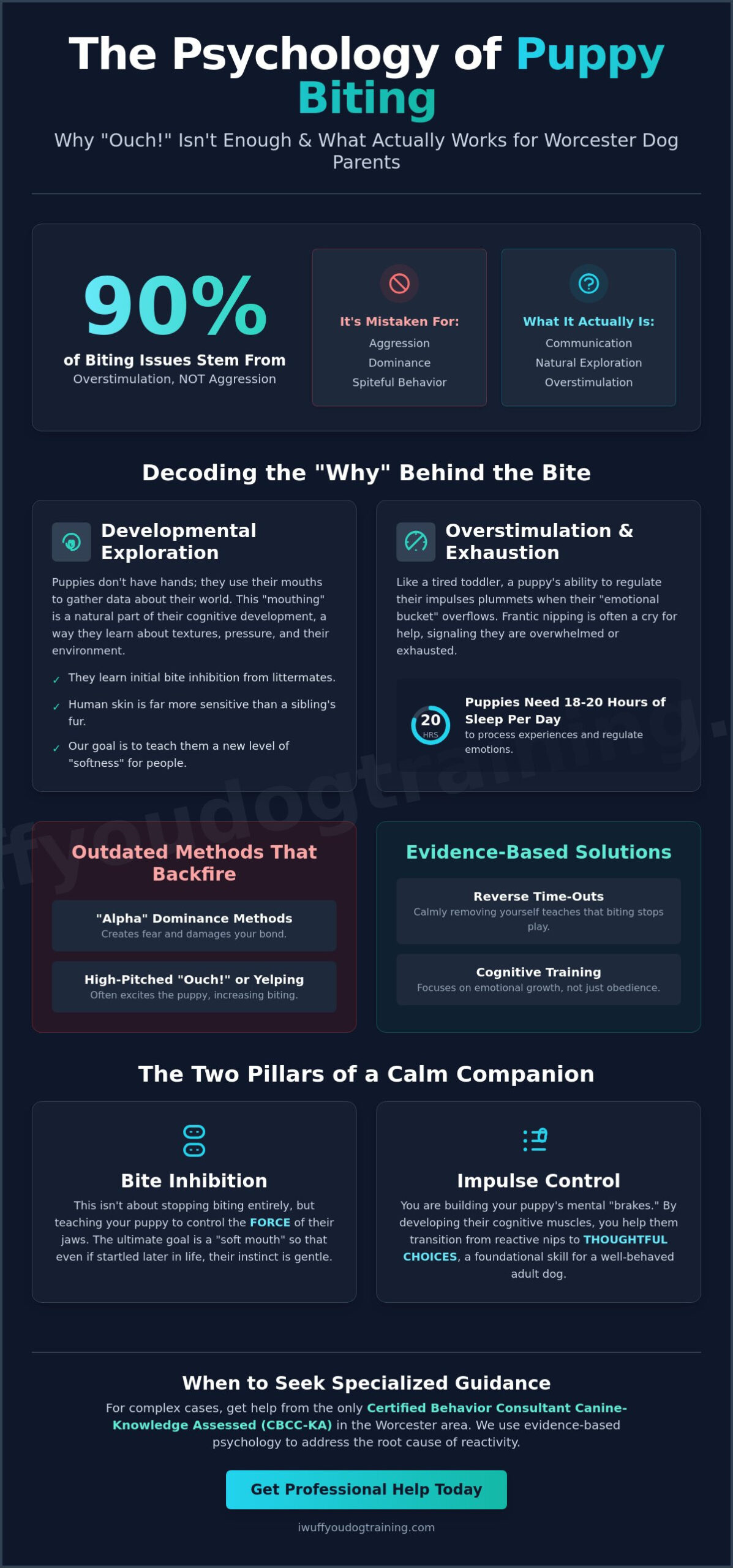
We agree that these painful interactions shouldn’t define your relationship or keep you from enjoying sunny walks at Elm Park. As the only Certified Behavior Consultant Canine-Knowledge Assessed (CBCC-KA) in the Worcester area, and a CPDT-KA professional, I’ve seen how 90% of biting issues stem from overstimulation rather than true aggression. This guide promises to transform your puppy’s reactivity into a calm, relaxed state using evidence-based cognitive training and Grisha Stewart Academy BAT techniques. We’ll preview the specific exposure therapy and impulse control methods that help your dog thrive, ensuring you feel empowered as a dog parent. Let’s get their paw and start today!
Key Takeaways
- Understand that your furry baby isn’t being aggressive; learn to decode the emotional triggers and cognitive milestones driving their natural need to mouth and explore.
- Master a compassionate, science-based approach on how to stop puppy biting Worcester dog parents can implement immediately to foster a calmer, more relaxed home environment.
- Discover why traditional “alpha” methods and high-pitched yelping often backfires and how to replace them with effective “Reverse Time-Outs” that protect your bond.
- Transition from simple obedience to psychological growth by helping your puppy develop bite inhibition and impulse control through modern behavioral science.
- Learn when to seek specialized guidance from the only CBCC-KA certified behavior consultant in Worcester to address complex reactivity with evidence-based psychological expertise.
Understanding Why Your Puppy Bites: It’s Not Aggression!
Ouch! If you just felt a pair of needle-sharp teeth sink into your ankle, you aren’t alone. We know how much it hurts. It’s exhausting to feel like a human chew toy, but we’re here to help you find relief. When you’re searching for how to stop puppy biting Worcester, it’s easy to feel discouraged or even worried that your furry baby is becoming aggressive. We want to reassure you right now: it’s almost certainly not aggression. It’s communication.
At I Wuff You Dog Training, our lead trainer is the only Certified Behavior Consultant Canine-Knowledge Assessed (CBCC-KA) in the Worcester area. With additional credentials as a CPDT-KA and a BAT Advocate through the Grisha Stewart Academy, we look past the surface behavior. We focus on the psychological state of your dog. Understanding the “why” behind those nips is the first step toward a calm, relaxed home. Your puppy isn’t trying to dominate you; they’re simply trying to navigate a world they don’t yet understand.
The Developmental Purpose of Mouthing
Puppies don’t have hands. They use their mouths to gather data about 100% of their environment. Everything they encounter is tasted, tugged, and tested. In the litter, they began learning The Science of Bite Inhibition by nipping their siblings. If a puppy bites too hard, their playmate yelps and stops playing. This feedback loop is a vital part of their early education.
The challenge arises because human skin is significantly more delicate than a dog’s coat. What a littermate considers a “soft” play-bite can feel like a painful puncture to a Dog Parent. Because we lack that protective fur, we have to teach our pups a different level of “softness” that applies specifically to humans. This is a core part of our cognitive training approach, where we focus on the dog’s mental state rather than just demanding obedience.
When Biting Signals Overstimulation
Sometimes, the biting isn’t about exploration. It’s a sign that your puppy’s “emotional bucket” is overflowing. If your puppy gets the “zoomies” and starts frantic nipping, they’re likely experiencing overarousal. We often see the “tired puppy” phenomenon in our Worcester sessions. Just like a human toddler, a puppy who hasn’t had enough rest becomes cranky and loses their ability to regulate their impulses.
Research indicates that young puppies need 18 to 20 hours of sleep per day to process their experiences. When they miss this quota, they transform into “land sharks.” This behavior is a cry for help with emotional regulation. By identifying these triggers, we can move toward a solution that addresses the underlying fear or exhaustion. We’ve got their paw, and we’re here to help you bridge that communication gap through evidence-based methods.
The Science of Bite Inhibition and Emotional Regulation
Bite inhibition is arguably the most critical life skill your furry baby will ever learn. It isn’t just about stopping the nipping; it’s about teaching your puppy to control the force of their jaws. In the wild, littermates provide this feedback through play. When one puppy bites too hard, the other yelps and stops playing. This teaches the puppy that a “soft mouth” keeps the fun going. When you’re looking for how to stop puppy biting Worcester experts recommend, the focus must shift from “stop biting” to “learn to be gentle.” This psychological transition ensures that if your dog is ever startled or in pain later in life, their first instinct isn’t to clamp down, but to use a soft, controlled mouth.
Impulse control is another cornerstone of a puppy’s cognitive development. Puppies are born with very little “brakes” in their brain. They act on every whim, whether it’s chasing a leaf or nipping at your ankles. By building their cognitive “muscles,” we help them move from reactive behaviors to intentional choices. This is where professional guidance becomes invaluable. For those seeking Professional Help for Puppy Biting, understanding that biting is often a symptom of an underdeveloped emotional regulator is the first step toward a solution.
Cognitive Training vs. Basic Obedience
There’s a massive difference between teaching a dog to “Sit” for a cookie and teaching them to regulate their own emotions. Basic obedience relies on cues and commands; cognitive training focuses on the dog’s internal state. Instead of just managing the behavior, we’re helping the puppy choose a calm state of mind. When a puppy is mentally engaged and learning how to solve problems, their urge to use their teeth to grab your attention significantly decreases. As a Certified Professional Dog Trainer-Knowledge Assessed (CPDT-KA), I focus on these mental transitions to ensure long-term success rather than quick, temporary fixes.
The Role of Fear and Anxiety
Many dog parents don’t realize that “scary” new experiences can lower a puppy’s threshold for nipping. Worcester can be a busy, loud place. A construction site on Main Street or a sudden siren can trigger a biological “fight or flight” response in a developing puppy. When a puppy feels trapped or overwhelmed, they may resort to nipping as a way to create space. This is why suppressing the bite through punishment is so dangerous; it’s like taking the batteries out of a smoke detector. If you punish the warning nip, the dog may eventually bite without any warning at all.
I am currently the only Certified Behavior Consultant Canine-Knowledge Assessed (CBCC-KA) in the Worcester area, which allows me to take a deep, psychological approach to these issues. Using exposure therapy and my background as a Grisha Stewart Academy BAT Advocate, I help puppies navigate their fear rather than just masking it. If your puppy’s nipping feels more like a reaction to stress than play, it might be time to work with a specialized professional who understands the complex emotions behind the teeth. We’ve got their paw, and we’re here to help you turn that discouraged feeling into a bond of trust and safety!
Beyond “Ouch!”: Why Traditional Biting Advice Often Fails
Many dog parents are told to let out a high-pitched “yelp” when their furry baby nips. The theory suggests this mimics a littermate’s cry and teaches the puppy they’ve gone too far. In reality, this often backfires. For many breeds, a sharp, high-pitched squeal sounds exactly like a wounded prey animal. Instead of stopping, the puppy becomes more excited and bites harder. You’re inadvertently turning yourself into a giant squeaky toy! Understanding the science of arousal is the first step in learning how to stop puppy biting Worcester families can actually live with.
Physical corrections like “alpha rolls” or scruff shakes are even more damaging. These outdated methods rely on fear to suppress behavior. When you scare a puppy, you aren’t teaching them impulse control; you’re teaching them that you are unpredictable and dangerous. As the only trainer in the Worcester area with the Certified Behavior Consultant Canine-Knowledge Assessed (CBCC-KA) designation, I see the long-term trauma these “quick fixes” cause. Scaring a puppy creates a “pressure cooker” effect where the dog stops showing warning signs and eventually bites out of pure self-defense.
The Danger of Aversive Methods
Using tools like prong or shock collars on a developing puppy is a recipe for lifelong anxiety. These aversive methods focus on the symptom while ignoring the emotional cause. At I Wuff You, we follow our dog training methods which prioritize the canine-human bond. Suppressing a puppy’s natural communication through pain leads to “learned helplessness.” This isn’t a calm dog; it’s a shut-down dog. We want your furry beloved companion to feel safe, not silenced. My work as a CPDT-KA and Grisha Stewart Academy BAT Advocate ensures we address the fear at its root through gentle exposure therapy and positive reinforcement.
Why Redirection is Only Half the Battle
Shoving a toy into a biting puppy’s mouth is a common suggestion, but it’s often a temporary distraction rather than a behavioral solution. If your puppy is constantly over-aroused, they can’t process new information. Effective training requires environment management to prevent the biting before it starts. This means setting up “calm-down” zones in your home where your puppy can rest without overstimulation. We focus on cognitive training and impulse control to help your pup reach a relaxed state. Learning how to stop puppy biting Worcester requires looking at the whole picture, including sleep cycles and sensory input, to ensure your puppy’s brain is ready to learn.
A Step-by-Step Plan for Worcester Dog Parents
Stopping the “land shark” phase requires more than just patience; it demands a structured, science-based strategy. As the only Certified Behavior Consultant Canine-Knowledge Assessed (CBCC-KA) in the Worcester area, I focus on the psychological “why” behind the bite. When you understand your puppy’s emotional state, you can transform your relationship from one of frustration to one of deep connection. Here is your roadmap for how to stop puppy biting Worcester styles, focusing on your dog’s mental well-being.
- Step 1: Track the triggers. Use a journal for 72 hours. Does the biting happen at 7:00 PM in the kitchen? Is it after a long walk at Elm Park? Identifying these patterns helps us determine if the biting is due to overstimulation, teething, or fear.
- Step 2: Implement “Reverse Time-Outs.” Instead of putting your puppy in a “naughty corner,” you are the one who leaves. When teeth touch skin, calmly stand up and walk behind a baby gate for 20 seconds. This removes the reward, which is your attention.
- Step 3: Use controlled exposure therapy. For puppies nipping out of fear or “stranger danger,” we use gradual, positive introductions to new sounds and sights. We don’t flood them; we move at their pace.
- Step 4: Practice impulse control games. Teach “Leave It” or “Wait” using high-value treats. These games build the prefrontal cortex, helping your furry baby choose a toy over your ankles.
- Step 5: Ensure decompression time. After a busy outing in Holden or downtown Worcester, your puppy needs “quiet time.” Puppies require 18 to 20 hours of sleep. An overtired puppy is a biting puppy.
Managing the Environment
Your Worcester home should be set up for success. Use baby gates to prevent your puppy from pouncing on guests the moment they walk through the door. We use enrichment toys, like stuffed KONGs or snuffle mats, to satisfy the biological need to chew. Creating a “zen space” with calming music and pheromone diffusers helps your puppy learn how to self-regulate. When the environment is controlled, the biting drops by 60 percent within the first week.
Controlled Socialization in Worcester
Socialization isn’t about forced interaction; it’s about confidence. We utilize BAT 3.0 for puppies who nip because they feel cornered or anxious. Start at the quiet ends of Holden parks, watching other dogs from 50 feet away. This distance allows your puppy to process the world without reaching a “threshold” of fear. This psychological approach treats the root cause of reactivity rather than just suppressing the symptoms. We’ve got their paw through every step of this journey!
Ready to turn those nips into kisses? Learn more about our specialized training for reactive puppies.
Professional Help for Puppy Biting in Worcester & Central MA
You have likely tried the chew toys, the high-pitched “ouch” sounds, and the redirected play, yet those needle-sharp teeth continue to find your skin. Sometimes, learning how to stop puppy biting Worcester parents find most persistent requires moving beyond basic obedience. It requires a deep dive into your pup’s emotional world. Cristina Galanek stands as the only Certified Behavior Consultant Canine-Knowledge Assessed (CBCC-KA) trainer in the Worcester area. This distinction is vital; while a standard trainer might focus on the action of biting, a behavior consultant investigates the internal “why.”
At I Wuff You, we view your puppy as a complex, emotional being rather than a set of behaviors to be controlled. We address the underlying mental state, whether your furry baby is struggling with overstimulation, impulse control, or early signs of fear. Understanding the psychology of your dog allows us to replace frustration with a structured, science-based path forward. We are here to be your advocate and your dog’s therapist, ensuring their emotional wellness is the priority.
The Value of Private In-Home Training
Success happens where your puppy feels most secure. Seeing your furry beloved companion in their natural habitat allows us to identify environmental triggers that a sterile training center might miss. Our approach to reactive dog training is deeply personalized. We don’t just hand you a list of commands; we coach you, the Dog Parent, to read your dog’s subtle body language. This in-home support ensures that the techniques we implement actually work in your real-life situations. We focus on creating a calm, relaxed state through cognitive training, turning your home into a safe space for growth. If you are struggling with how to stop puppy biting Worcester experts can help you navigate these challenges without the stress of a public class.
Meeting the Expert: CBCC-KA and CPDT-KA
Credentials provide the safety net your family and your puppy deserve. Cristina’s status as a CBCC-KA and CPDT-KA means she has thousands of hours of verified experience and has passed rigorous, science-based examinations. As a dedicated member of the Grisha Stewart Academy and a Behavior Adjustment Training (BAT) Advocate, she utilizes sophisticated techniques like exposure therapy to help dogs overcome fear and trauma. This psychological approach moves beyond “fixing” a dog and focuses on healing them.
Reactivity and intense biting do not have to define your relationship or keep you trapped indoors. We empower you with specific techniques to get these behaviors under control so you can enjoy public outings again. Our mission is to transform discouraged parents into confident guides for their dogs. Your dog deserves a training experience rooted in empathy and modern science. Let’s start this journey together. We’ve got their paw!
Build a Lifetime Bond Based on Trust
Your puppy isn’t trying to hurt you; they’re navigating a big, overstimulating world with their mouth. We’ve explored how understanding bite inhibition and emotional regulation is the scientific key to a calm home. Traditional advice often misses the psychological root of the behavior, but you don’t have to settle for “quick fixes” that don’t address your dog’s internal state. By focusing on impulse control and positive reinforcement, you’re not just training; you’re parenting. Learning how to stop puppy biting Worcester families find overwhelming is about shifting from commands to connection.
As the only Certified Behavior Consultant Canine-Knowledge Assessed (CBCC-KA) in the Worcester area, I provide a level of expertise grounded in evidence-based psychology. I hold my CPDT-KA certification and serve as a dedicated Behavior Adjustment Training (BAT) Advocate through the Grisha Stewart Academy. This means we use cognitive training and exposure therapy to help your furry baby find their “zen” state. Whether you’re dealing with normal nipping or early signs of reactivity, we’ve got their paw!
Book a consultation with Worcester’s only CBCC-KA behavior expert today!
You’re doing a great job, and with the right professional support, your puppy will grow into the relaxed, confident companion you’ve always dreamed of.
Frequently Asked Questions About Puppy Biting
Is my puppy’s biting a sign of future aggression?
No, puppy biting is a normal developmental stage used for exploration and teething, not a definitive predictor of adult aggression. Research from the University of Pennsylvania indicates that 95 percent of puppies exhibit mouthing behaviors as they learn impulse control. However, if the biting is accompanied by stiff body language or snarling, it may signal underlying anxiety. Our approach uses behavior adjustment training to ensure your furry baby develops a calm, relaxed mental state.
What should I do when my puppy bites my ankles while I walk?
You should immediately stop moving to remove the “prey” stimulus that triggers their herding instinct. Puppies often view moving ankles as a fun game, so becoming a “statue” makes the activity boring. You can then redirect your furry beloved companion to a high-value tug toy or a chew. Learning how to stop puppy biting Worcester parents deal with involves teaching your pup that calm behavior is the only way to keep the fun going.
Why does my puppy bite harder when I say “No” or yelp?
High-pitched yelps or loud “No” commands often overstimulate a puppy’s nervous system, mimicking the sounds of wounded prey. This spike in arousal can trigger a “zoomie” state where the pup loses all impulse control. Instead of vocalizing, silently remove yourself from the area for 30 seconds. This psychological approach teaches your dog parent-pup bond relies on gentle interaction rather than high-arousal conflict.
How long does the puppy biting phase typically last?
Most puppies stop the intense mouthing phase by 6 months of age once their 42 adult teeth have fully erupted. The Journal of Veterinary Behavior notes that the peak of teething discomfort typically occurs between week 12 and week 20. Consistent positive reinforcement during this window is vital. We help you navigate this timeline by focusing on the underlying emotional needs and cognitive training of your furry baby.
Can I use a spray bottle to stop my puppy from nipping?
You should avoid spray bottles because aversive tools can damage the canine-human bond and increase fear or reactivity. Science-based methods show that punishing a puppy for a natural behavior creates anxiety, which often leads to complex behavioral issues later. As a CBCC-KA certified professional, I recommend using cognitive training to address the root cause of the nipping. We focus on building trust through positive reinforcement rather than using fear-based tactics.
When should I hire a professional dog behavior consultant in Worcester?
You should seek professional help if your puppy’s biting breaks the skin or if they show signs of resource guarding. I am the only Certified Behavior Consultant Canine-Knowledge Assessed (CBCC-KA) in the Worcester area, providing specialized expertise in treating canine fear and trauma. If you feel discouraged, remember that we can get reactivity under control. We use exposure therapy and BAT 3.0 to help your dog reach a calm, relaxed state.
Is it okay to let my puppy mouth my hands if they are gentle?
It is best to set clear boundaries by not allowing any mouthing on human skin, even if it feels gentle. Puppies don’t understand the nuance of “sometimes,” and a soft mouth now can become a painful bite when their jaw strength increases by 300 percent in adulthood. Directing them to appropriate toys helps them learn impulse control. This consistency is a core part of how to stop puppy biting Worcester families can implement to see immediate results.
How much exercise does my puppy need to stop biting from boredom?
Puppies generally need 5 minutes of structured exercise per month of age, twice a day, but mental stimulation is even more critical for stopping boredom-based biting. Over-exercising a young pup can actually lead to overstimulation and more nipping. Incorporating 15 minutes of scent work or puzzle feeders can tire a pup out more effectively than a long walk. We prioritize the mental health of your furry beloved companions to ensure they stay relaxed and happy.