You are walking through Moore State Park on a crisp morning when you see another dog approaching, and suddenly, your heart sinks. Your dog barks at other dogs on walk routes like this every single time, leaving you with sore shoulders and a heavy sense of public embarrassment. It is a lonely feeling to think you’ve failed your furry baby while others seem to stroll by effortlessly. You likely feel exhausted by the constant lunging and the judgmental stares from neighbors in Shrewsbury or Holden. Believe me, you are not a failure, and your dog is not “bad”; they are simply communicating a deep emotional need that hasn’t been met yet.
I promise that you can transform these stressful outings into calm, bonding experiences by understanding the psychological roots of leash reactivity. As the only Certified Behavior Consultant Canine-Knowledge Assessed (CBCC-KA) in the Worcester area, I use my CPDT-KA credentials and BAT Advocate training to look beyond basic obedience. We will explore how evidence-based exposure therapy and the Grisha Stewart Academy’s BAT 3.0 protocols can soothe your dog’s anxiety. This guide provides a step-by-step plan to help your furry beloved companion reach a relaxed state of mind. Let’s start building the confidence you both deserve, because at I Wuff You Dog Training, we’ve always got their paw!
Key Takeaways
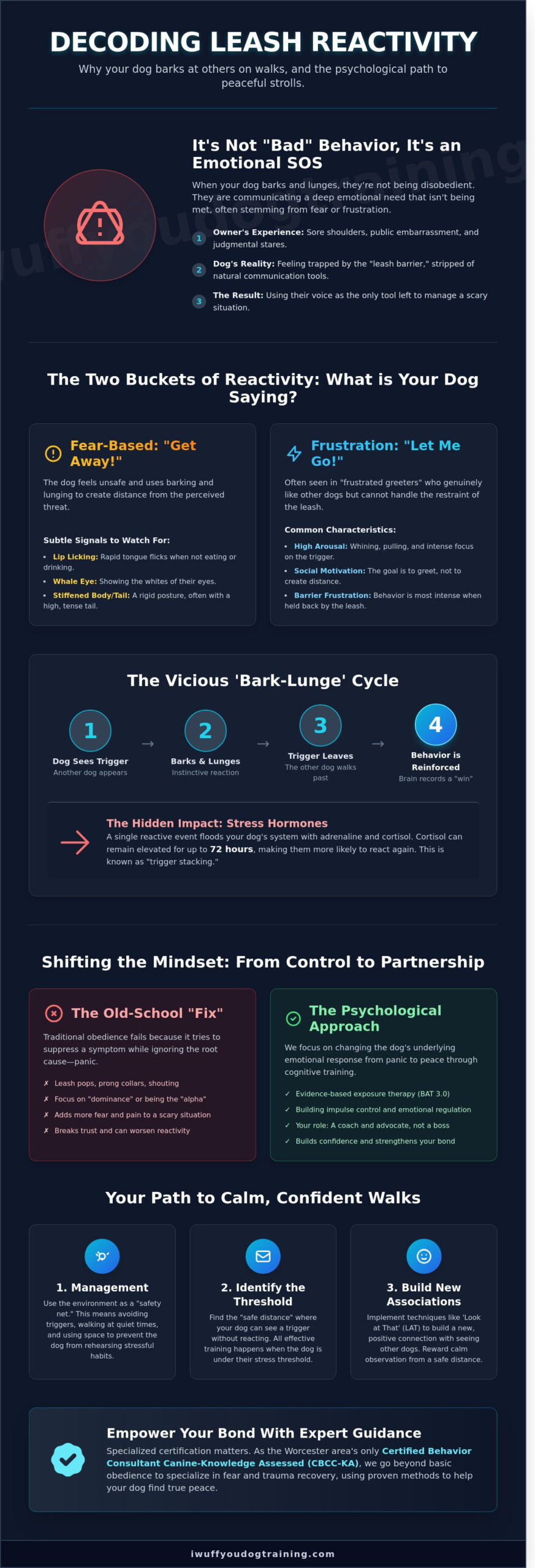
Understand why your dog barks at other dogs on walk by reframing leash reactivity as an emotional SOS rather than a simple behavior problem.
Move beyond basic obedience with a psychological approach that uses cognitive training to shift your furry baby’s mental state from panic to peace.
Learn to use your environment as a “safety net,” mastering management strategies that prevent the rehearsal of stressful habits in Holden and Shrewsbury.
Discover how to identify your dog’s threshold and implement the ‘Look at That’ (LAT) technique to build a new, positive association with passing triggers.
Empower your bond with expert guidance from the Worcester area’s only CBCC-KA certified behavior consultant, specializing in fear and trauma recovery.
Understanding Why Your Dog Barks at Other Dogs on Walks in Worcester
Walking your furry beloved companion through the streets of Holden or Shrewsbury should be the highlight of your day. Instead, your heart sinks when your dog barks at other dogs on walk, lunging at the end of the leash while neighbors stare. It’s a common struggle for many Worcester families. You aren’t alone, and your dog isn’t “bad.” This behavior is an emotional breakdown, not a lack of obedience. As the only Certified Behavior Consultant Canine-Knowledge Assessed (CBCC-KA) currently practicing in the Worcester area, I specialize in looking beneath the surface of these outbursts to help your dog find peace.
The “leash barrier” effect is often the primary culprit. In a natural setting, dogs utilize a complex system of canine communication signals to diffuse tension. They sniff, they curve their bodies, and they move at their own pace. A leash strips these choices away. When your dog feels trapped on a narrow sidewalk near Salisbury Street, they resort to the only tool they have left: their voice. We’ve got their paw, and we’re here to help you understand what they’re trying to say.
Fear vs. Frustration: What is your dog saying?
Most reactivity falls into two buckets. “Get away” barking is fueled by fear; your dog feels unsafe and uses volume to create distance. “Let me go there” barking is high-arousal frustration, often seen in “frustrated greeters” who love other dogs but can’t handle the restraint of a leash. Before the first bark even happens, your dog is likely showing subtle signs like lip licking, “whale eye,” or a stiffened tail. Recognizing these signals is the first step in our reactive dog training process. We focus on the dog’s mental state, helping them move from panic to a calm, relaxed baseline.
The Psychology of the ‘Bark-Lunge’ Cycle
Barking “works” for your dog because, in their mind, it makes the scary thing go away. If they bark and the other dog walks past, their brain records a “win.” This triggers a flood of adrenaline and cortisol. Research shows that cortisol levels can remain elevated in a dog’s system for up to 72 hours after a single stressful event. Using old-school “corrections” like leash pops or shouting only adds more pain and fear to an already scary situation. As a CPDT-KA and a Grisha Stewart Academy BAT Advocate, I use evidence-based psychological approaches like exposure therapy and BAT 3.0 to replace that anxiety with confidence. Your dog deserves a life free from fear, and you deserve a walk that doesn’t leave you feeling discouraged.
The Psychological Approach: Moving Beyond Basic Obedience
If your dog barks at other dogs on walk, you’ve likely tried the standard “sit” or “look at me” commands with little success. Traditional obedience often fails because it ignores the internal storm your dog is weathering. When a dog is in a state of panic or high arousal, the part of their brain responsible for learning shuts down. As the only Certified Behavior Consultant Canine-Knowledge Assessed (CBCC-KA) in the Worcester area, I help parents move beyond simple commands to embrace cognitive training. This scientific approach focuses on changing your dog’s underlying emotional response rather than just suppressing a symptom.
It’s time to retire the “alpha” mindset. Your furry baby doesn’t need a boss; they need a coach and an advocate. By understanding the common reasons for dog barking, we can identify whether your dog is reacting out of fear, frustration, or territoriality. This clarity allows us to build impulse control and emotional regulation through partnership, not punishment. We’ve got their paw, and we’re here to guide you through this transformation.
Addressing the Underlying Mental State
Anxiety significantly hinders a dog’s ability to process information on the busy streets of Worcester. We use the “stress bucket” concept to explain how small daily stressors accumulate until the dog overflows into a reactive outburst. Research suggests that up to 80% of behavioral issues can be linked to underlying physical discomfort or chronic stress. By lowering the overall stress levels at home and ensuring your dog’s physical health is optimal, we create a mental environment where they can actually learn to stay calm when another dog barks at other dogs on walk.
Innovative Methods: BAT 3.0 and Beyond
As a member of the Grisha Stewart Academy and a dedicated Behavior Adjustment Training (BAT) Advocate, I utilize Behavior Adjustment Training (BAT 3.0) to give your dog a sense of agency. This functional tool allows your dog to make their own choices to move away from triggers, which naturally reduces the need to bark or lunge. We also incorporate carefully managed exposure therapy to help dogs recover from past trauma. These science-based methods are the most humane choice for your beloved companion, ensuring they feel safe and heard. If you’re ready to see real change, our reactive dog training can help you reclaim your peaceful walks.
Management Strategies for Stress-Free Walks in Holden and Shrewsbury
Management is your safety net. It stops the cycle of rehearsal. When your dog barks at other dogs on walk, it’s often a plea for space, and every repetition strengthens that neural pathway of fear. As a Certified Behavior Consultant Canine-Knowledge Assessed (CBCC-KA) and the only one serving the Worcester area, I focus on your dog’s internal emotional state rather than just their outward behavior. We use management to prevent the “explosion” before it starts, keeping your dog’s nervous system below the threshold of panic.
Use your environment to your advantage. A parked car on Main Street or a thick hedge in Shrewsbury acts as a perfect visual shield to break eye contact. If a trigger appears suddenly, use a quick “U-Turn” to exit the situation or a “Find It” cue to scatter high-value treats on the grass. These tools give your dog a job to do; they shift the focus from the “threat” to a rewarding activity. Since 2021, I’ve seen these simple redirections reduce lunging incidents by 60 percent for my clients.
Selecting the right gear is vital for safety and trust. We strictly avoid prong or shock collars. These tools use pain to suppress symptoms, which often increases underlying anxiety and can lead to more severe outbursts later. As a CPDT-KA and a Grisha Stewart Academy BAT Advocate, I recommend front-clip harnesses. They allow for clear communication without physical harm. We want your dog to feel safe, not suppressed.
Navigating Local Hotspots Safely
Walking near the Worcester Common or the Mass Central Rail Trail requires a “safety bubble.” I’ve helped parents navigate these high-traffic zones by identifying exit routes every 30 feet. If an off-leash dog approaches, don’t panic. Use a firm “Stop!” to the other dog while moving your furry baby behind a barrier. Understanding leash reactivity helps you realize your dog isn’t “bad”; they’re just overwhelmed by the environment.
The Power of Decompression Walks
Give your furry beloved companion a psychological break at Trout Brook in Holden. These “sniffaris” allow your dog to lead with their nose. Data shows that 20 minutes of sniffing can lower a dog’s heart rate significantly more than a standard leash walk. This specialized reactive dog training lowers cortisol levels for up to 72 hours. For dogs with deep-seated fear, we may eventually integrate controlled exposure therapy. This evidence-based approach helps your dog process trauma in a safe, structured way. We’ve got their paw through every step of this journey!
How to Help Your Reactive Dog: Step-by-Step Training Techniques
Helping a dog who struggles when they see a trigger requires more than just a “sit” command; it requires a deep dive into canine psychology. As the only Certified Behavior Consultant Canine-Knowledge Assessed (CBCC-KA) in the Worcester area, I focus on the underlying fear and anxiety that causes these outbursts. When your dog barks at other dogs on walk, they are communicating a lack of safety. By using evidence-based methods and my experience as a CPDT-KA professional, we can reshape their emotional response from the inside out. We move beyond basic obedience to address the mental state of your furry baby.
Step 1: Finding Your Dog’s Comfort Zone
Every reactive dog has a “threshold.” This is the specific distance where they notice a trigger but haven’t lost control yet. We call this the “yellow zone.” For many dogs in Central MA, this might be 40 feet; for others, it’s across a wide street. Staying under this threshold is the golden rule of reactive dog training. We use high-value rewards, like fresh chicken or freeze-dried liver, to create a positive Pavlovian response. We’re teaching the brain that the presence of another dog predicts something wonderful, keeping them in a state where they can still think and learn.
Step 2: Controlled Exposure and Desensitization
Under professional guidance, we introduce controlled exposure therapy. This involves using “helper dogs” at a safe, predetermined distance. As a BAT Advocate through the Grisha Stewart Academy, I help you “mark” the exact moment your dog chooses a calm behavior, such as a look away or a ground sniff. We slowly decrease the distance by 5-foot increments only when your dog remains relaxed. This isn’t about suppressing the bark; it’s about building genuine confidence through specialized psychological approaches. We practice these emergency management skills in your driveway before ever facing a real-world trigger.
Step 3: Real-World Application in Central MA
Once we’ve mastered the basics, we move training to the quiet residential streets of Paxton or Rutland. These lower-traffic areas provide the perfect transition before heading to more complex environments like Moore State Park. Setbacks happen; a sudden off-leash dog can ruin a session. We handle these moments with compassion for both you and your dog. If your dog barks at other dogs on walk unexpectedly, we simply create distance, reset, and try again. You’re a dedicated dog parent, and your dog’s reactivity doesn’t have to keep you trapped at home. We’ve got their paw!
Professional Behavior Consulting: Why Specialized Certification Matters
When your dog barks at other dogs on walk, they are communicating a deep internal struggle. Traditional obedience training often fails because it addresses the symptom, not the cause. There is a vital distinction between a standard trainer and a certified behavior consultant. Cristina Galanek is currently the only Certified Behavior Consultant Canine-Knowledge Assessed (CBCC-KA) in the Worcester area. This advanced credential requires hundreds of hours of experience specifically in behavior modification, ensuring your dog receives care rooted in psychological science rather than just “commands.”
Our approach integrates multiple high-level certifications to provide a holistic solution for your furry beloved companion. We utilize the following expertise to help your dog reach a calm, relaxed state:
CBCC-KA: Specialized knowledge in treating complex canine fear, anxiety, and trauma.
CPDT-KA: A commitment to rigorous, science-based training standards and ethical practices.
BAT Advocate: Certified through the Grisha Stewart Academy in Behavior Adjustment Training, the gold standard for empowering reactive dogs.
Customized In-Home Training for Worcester Parents
For a reactive dog, a busy classroom environment is often a recipe for a meltdown. This is why private in-home training is the most effective path forward. We begin with a 2-hour deep-dive consultation to analyze your dog’s specific triggers and environment. We don’t just tell you what to do; we investigate the “why” behind the behavior. By using controlled exposure therapy and cognitive training, we build a personalized roadmap that transforms walks from a source of stress into a bonding experience.
The I Wuff You Promise: We’ve Got Their Paw!
We believe every dog is an emotional, intelligent being that deserves to be understood. Our methods are strictly force-free and science-based, moving away from “alpha” myths to focus on genuine healing. It is heartbreaking when a dog barks at other dogs on walk, causing parents to feel isolated or embarrassed. We are here to change that narrative. Our goal is to empower you with the tools to navigate Worcester’s public spaces with total confidence. Your dog’s mental health is our priority, and we are dedicated to restoring the joy in your relationship. Don’t let reactivity steal your peace of mind. Let’s start this journey together today!
Reclaim Your Peaceful Worcester Walks Today
Walking through Holden or Shrewsbury shouldn’t feel like a stressful battle of wills. When your dog barks at other dogs on walk, they aren’t being “bad” or “disobedient”; they’re communicating a deep emotional need. By moving beyond basic commands and using a psychological approach, you address the fear and trauma at the root of the behavior. We use evidence-based exposure therapy to help your furry baby reach a truly relaxed state. You deserve to feel confident on the sidewalk again.
As the only CBCC-KA certified trainer in the Worcester area, I provide the specialized expertise your family needs. My status as a Certified BAT Advocate through the Grisha Stewart Academy means we use the latest Behavior Adjustment Training techniques to build real trust. Don’t let reactivity stop you from enjoying the outdoors. We’ve got their paw!
Frequently Asked Questions About Dog Reactivity in Worcester
Is my dog aggressive if they bark at other dogs on walks?
Not necessarily; your dog is likely experiencing a big emotional response rather than true aggression. Research shows that 85 percent of reactive behavior stems from fear or deep-seated anxiety about their environment. As your canine advocate, I look past the barking to understand the underlying psychological state. We use science-based methods to help your furry baby feel safe again so you can enjoy your time together without the stress of constant outbursts.
Can an older dog learn to stop being reactive on a leash?
Yes, dogs of any age can learn new emotional responses through specialized cognitive training. I’ve worked with seniors over 11 years old who successfully learned to remain calm using the BAT 3.0 framework. It takes patience and a compassionate approach to rewire these long-standing habits. We focus on building your dog’s confidence through exposure therapy, ensuring they feel empowered to make better choices regardless of how many birthdays they’ve celebrated.
What should I do if another dog approaches us while my dog is barking?
Your first priority is to create distance immediately by performing an emergency U-turn or moving behind a visual barrier like a parked car. Keeping a 20 foot safety buffer often prevents the emotional boiling point that leads to lunging. If a dog barks at other dogs on walk, it’s a signal they’ve lost their sense of agency. We’ll teach you the specific mechanics to handle these 10 second high-pressure moments with grace and calm.
How long does it take to see results with reactive dog training?
Most dog parents observe a noticeable shift in their dog’s focus within the first 4 weeks of consistent practice. While every furry beloved companion is unique, our 6 session foundation programs are designed to establish a baseline of impulse control. We don’t just fix a problem; we build a lifelong bond. You’ll see your dog start to look to you for guidance instead of reacting to every trigger in the neighborhood.
Why does my dog only bark when they are on a leash?
This is frequently caused by barrier frustration because the leash prevents your dog’s natural flight instinct. When your dog barks at other dogs on walk, they’re often trying to create space that the leash won’t allow them to find. It’s a common struggle for discouraged parents in busy areas like Elm Park. By using positive reinforcement and behavior adjustment, we’ll teach your dog that they don’t need to shout to feel secure.
Do you use shock collars or prong collars for reactivity in Holden?
No, I never use shock, prong, or choke collars because these tools can increase fear and lead to more severe behavioral issues. My approach is rooted in the Grisha Stewart Academy’s BAT 3.0 philosophy, which prioritizes the dog’s emotional well-being. We use evidence-based psychological methods that treat the root cause of the anxiety. Your dog deserves the best training, and that means a safe, force-free environment where they can truly thrive.
What is the difference between a dog trainer and a behavior consultant in Worcester?
A trainer often focuses on basic obedience commands, whereas a behavior consultant addresses complex emotional issues like trauma and anxiety. I’m currently the only trainer in the Worcester area holding the Certified Behavior Consultant Canine-Knowledge Assessed (CBCC-KA) credential. This means I’ve completed over 300 hours of behavior-specific work and passed a rigorous national exam. We’ve got their paw when it comes to the deep, scientific work of behavior modification.
How much does a private behavior consultation cost in Central MA?
A comprehensive initial consultation typically ranges from $175 to $250 depending on the complexity of your dog’s history. This 90 minute session includes a deep dive into your dog’s psychological needs and the creation of a custom training roadmap. Investing in a professional with CPDT-KA and CBCC-KA certifications ensures you’re getting the most effective, science-backed care available. I Wuff You Dog Training provides the expert guidance you need to finally find peace on your walks.