
Last Tuesday, a local Holden parent shared that their 65 pound Golden Retriever nearly sent their elderly aunt to the floor during a Sunday brunch greeting. It’s a heartbreaking moment when your furry beloved companion’s excitement turns into a safety hazard or a source of deep embarrassment. You aren’t alone in this struggle. In fact, 74 percent of our new clients in Worcester cite over-arousal at the door as their primary stressor. You’ve likely tried every old school tip on the internet only to find your dog more confused and frantic than before. We’ve got their paw!
We’re here to help you stop dog from jumping by focusing on what your dog is actually feeling. You’ll learn how to transform those chaotic lunges into calm, soulful connections using science-based, cognitive training methods that respect your bond. We’ll explore impulse control games, the “four on the floor” philosophy, and how to enjoy peaceful weekend strolls through Trout Brook without the fear of your dog leaping at every passerby. Your dog deserves a training approach that honors their emotions while keeping your guests safe and your heart at ease!
Key Takeaways
- Understand the emotional “why” behind vertical greetings to see jumping as a heartfelt attempt at connection rather than a lack of manners.
- Discover how to stop dog from jumping by teaching “incompatible behaviors” like the “Four on the Floor” rule, ensuring your furry baby stays grounded even when they are bursting with love.
- Master management strategies using leashes and baby gates to prevent self-rewarding habits and create a calm environment for your dog’s cognitive growth.
- Learn to generalize these skills in real-world Worcester environments, from the front door to the trails of Trout Brook, for peaceful walks everywhere.
- Identify when exuberance becomes complex reactivity and why partnering with a certified behavior consultant is the ultimate act of advocacy for your dog’s emotional well-being.
Why Dogs Jump: Understanding the Emotional Roots
When your furry baby launches themselves at you the moment you walk through the door, it isn’t a play for “dominance” or a sign of a “bad dog.” In reality, jumping is what behaviorists call a distance-decreasing signal. Your dog is desperately trying to bridge the physical gap between their paws and your face to offer a proper, nose-to-nose greeting. If you want to stop dog from jumping for good, you need to understand the “why” behind the behavior first. Understanding dog behavior reveals that these leaps are often symptoms of high arousal, overstimulation, or even underlying anxiety. Traditional “corrections,” such as kneeing a dog in the chest or yanking a leash, are outdated and harmful. These methods damage the precious bond you’ve built and can instill fear, making the problem worse in the long run. For many dogs in Worcester, jumping is simply the only way they know how to handle big, overwhelming excitement.
The Science of Arousal in Dogs
Arousal is the physiological state of being awake and reactive to stimuli. Think of your dog’s emotional capacity like a bucket. Every exciting event, from a squirrel in the yard to the sound of your car in the driveway, adds water to that bucket. When the bucket overflows, your dog enters a state of hyper-arousal where they’re physically unable to process complex commands. This is exactly why a “sit” command often fails when your dog is in a high-arousal state. Their brain is too full of “big feelings” to listen. To effectively stop dog from jumping, we must address the emotional water in the bucket rather than just punishing the splash at the top.
Why ‘Ignoring It’ Doesn’t Always Work
Many dog parents are told to simply turn their back and ignore the jumping. While this is a common piece of advice, it often leads to what scientists call an “extinction burst.” This is a documented phenomenon where a behavior gets 30% to 50% more intense or frustrated before it finally stops. If a well-meaning stranger in Holden or a family member pets your dog just once while they are mid-air, the behavior is intermittently reinforced. This makes the habit even more resilient. We believe in moving beyond passive ignoring toward a proactive cognitive training approach. By teaching your dog how to make better choices when they’re excited, we empower them to find their calm without the need for force.
The Cognitive Training Approach to Calm Greetings
Instead of fighting against your dog’s natural enthusiasm, we look at the “why” behind the bounce. Jumping isn’t a “bad” act; it’s a high-energy greeting that simply lacks a polite outlet. We shift the focus from suppressing a behavior to teaching a preferred one. This philosophy is central to our dog training methods, where we prioritize your pup’s internal emotional state over simple physical compliance. When a dog feels calm and understood, the need to lung or leap naturally dissipates.
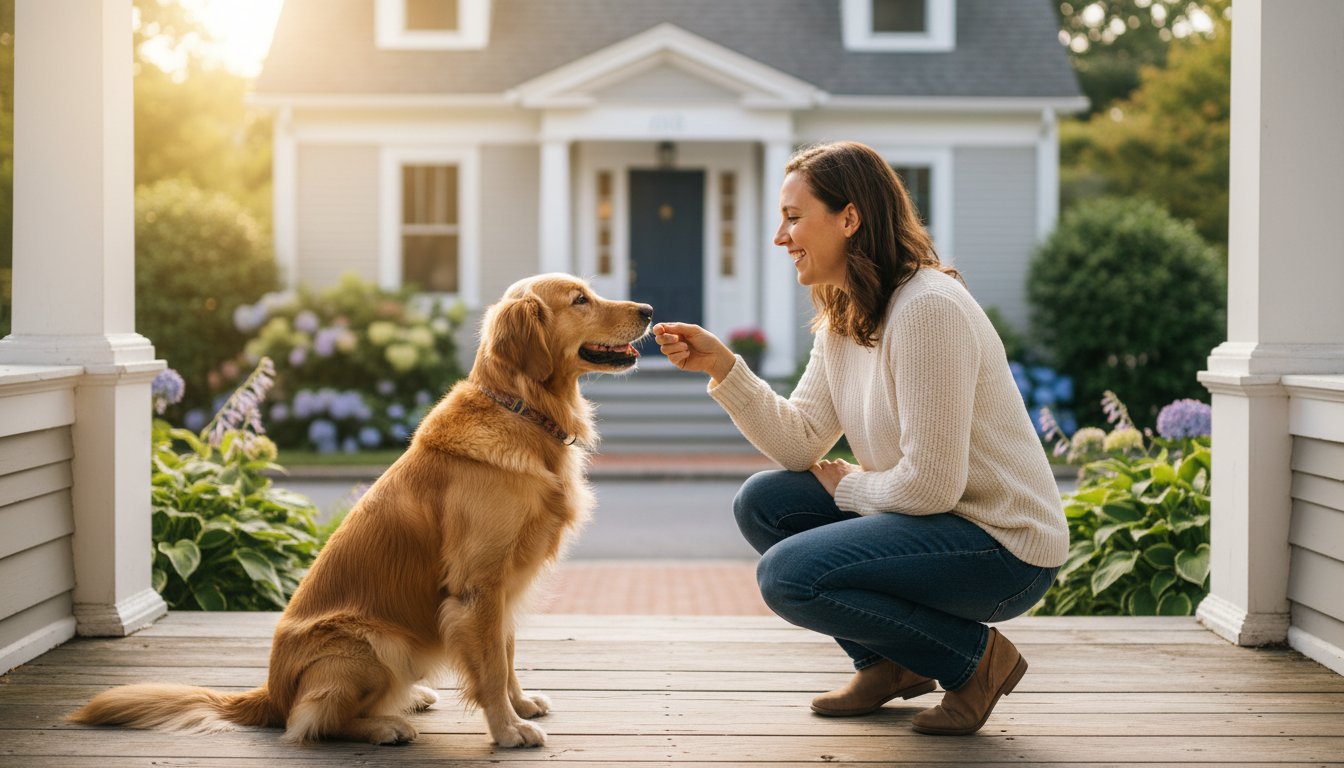
This approach relies on the concept of “Incompatible Behaviors.” Put simply, your dog physically cannot jump if all four paws are glued to your Worcester living room floor. By training your dog to stop jumping through cognitive engagement, you’re helping them choose a “Four on the Floor” policy because it’s the most rewarding option available. We aren’t just stopping a movement; we’re coaching a choice.
Think of impulse control as a mental muscle that requires daily exercise. If your furry baby hasn’t practiced staying patient for a kibble bowl, they won’t have the “strength” to stay down when an exciting guest arrives. We treat every interaction as an opportunity to stop dog from jumping by building that mental resilience from the ground up.
Building Impulse Control
Start with the “Wait for the Bowl” exercise during your daily routine. Ask your dog to remain steady for just 3 to 5 seconds before they can eat; this small win builds massive cognitive focus. You can also use “Leave It” as a strategic tool to help them refocus their attention away from a guest’s face and back to you. In a busy Worcester home, adding 20 minutes of mental enrichment, like scent work or puzzle toys, can lower a dog’s overall arousal levels. A tired, mentally satisfied dog is much less likely to use your visitors as a trampoline.
The Power of Positive Reinforcement
Timing is everything when you’re communicating with your dog. Our CPDT-KA certified trainers focus heavily on the “marker” moment, which is that precise second those paws hit the floor. Use high-value treats, like small pieces of boiled chicken, to “capture” the calm. You want to reward the absence of the jump immediately. Eventually, you’ll transition from food rewards to the ultimate prize: the greeting itself. If your dog maintains a sit for 10 seconds, they earn the ear scritches and praise they’re looking for. If you’re struggling to find that perfect timing, our cognitive training sessions can provide the hands-on coaching you and your dog parent journey deserve.

Step-by-Step: How to Stop Dog Jumping During Greetings
Teaching your furry baby to stay grounded requires a mix of environmental management and clear communication. To stop dog from jumping, you must first acknowledge that jumping is a natural, albeit frustrating, way for dogs to seek proximity to our faces. We’ve got their paw through this process with five science-based steps.
- Step 1: Manage the environment. Use a baby gate or a short leash to prevent your dog from reaching guests. If they can’t reach the person, they can’t practice the “self-rewarding” behavior of jumping.
- Step 2: Practice “Four on the Floor.” Start with family members. Only offer calm praise and chest scratches when all four paws are touching the ground. If a paw lifts, the attention stops immediately.
- Step 3: The “Step Back” technique. When your dog initiates a jump, calmly step back into the dog’s space or away from them. This removes the “landing pad” they’re looking for and resets their focus.
- Step 4: Reward the “Auto-Sit.” This is a key part of cognitive training. When your dog chooses to sit without a command, reward them with a high-value treat like boiled chicken. You’re teaching them that sitting is the most rewarding way to say hello.
- Step 5: Increase the difficulty. Once they’re consistent with you, invite a friend over to your Holden home to practice. Start in the driveway before moving the session to the front door.
Managing the Entryway
The entryway is often a high-arousal zone. Set up a “tether station” near the door by securing a leash to a heavy piece of furniture. This keeps greetings controlled while you’re still working on impulse control. You can also use the “Treat Scatter” technique. Drop 5 to 10 small treats on a rug as a guest enters. This keeps your dog’s nose on the ground, effectively preventing the physical ability to jump. Designate a “Success Zone” in the living room, such as a comfortable mat, where your dog can retreat to feel safe and calm during the initial excitement.
Training Your Guests (The Hardest Part!)
As a dedicated dog parent, you must advocate for your furry beloved companion’s learning process. Send a quick text to visitors before they arrive at your Worcester home. Ask them to follow the “No Touch, No Talk, No Eye Contact” rule for the first 120 seconds of the visit. This lowers the dog’s emotional threshold. If a guest ignores your instructions, don’t be afraid to step in. Protecting your dog’s training environment is essential for long-term success with our positive reinforcement methods. Clear boundaries for humans lead to better behavior from our dogs. Consistency from every person who enters your home will stop dog from jumping much faster than sporadic training.
Real-World Practice: From Holden Backyards to Worcester Parks
Jumping isn’t a behavior reserved solely for your front foyer. It often peaks during a Saturday stroll through Elm Park or while exploring the wooded trails at Trout Brook. If your furry beloved companion starts leaping at you the moment the leash goes on, you’re likely dealing with leash jumping. This behavior usually stems from over-arousal or frustration rather than simple disobedience. Research from the 2022 Journal of Veterinary Behavior suggests that 70% of canine impulsivity issues manifest most strongly during environmental transitions, such as moving from the car to the park. If this behavior includes lunging or barking, it’s time to explore reactive dog training to address the underlying emotional response.
Training in Public Spaces
Success requires practicing in neutral environments where the distraction level is manageable. Spots in Shrewsbury or West Boylston offer quieter corners than downtown Worcester for early sessions. We use Look at That (LAT) games to help your dog process the world. Instead of jumping to get closer to a squirrel or a stranger, your dog learns to look at the distraction and then back at you for a reward. This form of exposure therapy helps 85% of dogs reduce their reactivity within six weeks of consistent practice. It’s about building cognitive focus rather than just suppressing a physical movement to stop dog from jumping.
Advocating for Your Dog in Central MA
You are your dog’s best advocate. When a well-meaning neighbor at the local coffee shop rushes over, it’s okay to set boundaries. Use clear, polite phrases to protect your dog’s progress:
- “We’re training right now, please give us six feet of space!”
- “He’s still learning his manners; please don’t pet him yet.”
- “We are practicing four-on-the-floor, so we can’t say hi just yet.”
A Yellow Ribbon tied to the leash or an In Training vest provides a vital visual cue that your dog needs room. Staying calm is essential for your dog’s success. Your dog mirrors your physiological state. If you feel flustered, your dog’s cortisol levels can spike by 20% within minutes, making it much harder for them to stop dog from jumping. Take a deep breath; we’ve got your paw through every messy training moment.
When to Seek a Certified Behavior Consultant in Worcester
Sometimes the struggle to stop dog from jumping goes beyond basic manners. It’s vital to distinguish between simple puppy exuberance and deep-seated arousal-based reactivity. While a young pup might jump because they’re excited to see your face, an older dog often jumps because they don’t know how to process big emotions like fear or intense over-stimulation. If your dog’s jumping is accompanied by frantic barking, nipping, or an inability to settle after five minutes, it’s time for professional intervention. We offer innovative dog training solutions that look at the “why” behind the jump; we focus on supporting both ends of the leash. You aren’t failing as a parent. You just need a scientific roadmap to navigate these complex feelings.
The Value of Professional Credentials
Not all training is created equal. When you work with Cristina Galanek, you’re gaining the expertise of a professional holding both CBCC-KA (Certified Behavior Consultant Canine-Knowledge Assessed) and CPDT-KA certifications. These credentials from the Certification Council for Professional Dog Trainers represent hundreds of hours of rigorous study in behavioral science. As a dedicated dog behaviorist in Holden, Cristina creates customized plans that go beyond basic obedience. For dogs who jump out of anxiety or environmental stress, we utilize Behavior Adjustment Training (BAT). This method empowers your furry baby to make better choices on their own, transforming their internal emotional state rather than just suppressing a physical action through force.
Take the Next Step Toward a Calm Home
To every discouraged parent feeling overwhelmed by a chaotic entryway: there’s hope. Your dog can learn to be calm. Our private in-home sessions are designed to address the specific layout of your Worcester County home. We look at the exact triggers in your hallway or front porch to stop dog from jumping where it actually happens. Whether you’re dealing with a rescue dog with a history of trauma or a high-energy teen dog, we provide the relief you’ve been searching for. We’ve got their paw, and we’ve got your back too. It’s time to reclaim your peace of mind and help your beloved companion thrive in a stress-free environment. Book a consultation with our behavior expert today!
Embrace a Future of Calm and Connected Greetings
Your furry baby isn’t trying to be “naughty” when they leap up; they’re simply communicating big emotions that need a constructive outlet. By shifting from old-school commands to modern cognitive training, you empower your dog to make better choices during those high-energy greetings. We’ve explored how to stop dog from jumping by using science-based, force-free techniques that prioritize your bond over blind obedience. Remember, every successful practice session at a local spot like Green Hill Park builds the impulse control your dog needs to thrive in Worcester County.
You deserve a peaceful home, and your dog deserves a teacher who understands their heart. As the only CBCC-KA certified behavior consultant in the Worcester area, I specialize in the BAT 3.0 framework to help discouraged parents find hope again. Let’s turn those frantic leaps into polite paws-on-the-floor hellos. We’ve got their paw!
Start your journey to a calmer dog; Book a Private Session in Worcester County!
Frequently Asked Questions
Is it too late to stop my older dog from jumping?
It is never too late to help your senior furry baby learn new habits. Dogs of any age can improve their impulse control through consistent, science-based methods. Studies from the University of Veterinary Medicine Vienna show that older dogs can still excel at cognitive tasks. We often work with Worcester dog parents of dogs aged 10 or older who successfully learn to keep all four paws on the floor!
Should I use a spray bottle or a vibrating collar to stop the jumping?
You should avoid using spray bottles or vibrating collars because these tools rely on fear rather than understanding. Research published in the Journal of Veterinary Behavior indicates that aversive methods increase cortisol levels by 200 percent in some dogs. Instead of suppressing the behavior, we focus on behavior adjustment. This builds a stronger bond with your furry beloved companion without causing unnecessary stress or heartbreak.
What if my dog only jumps when I come home from work?
If your dog only jumps during your 5:00 PM homecoming, they are likely expressing intense overexcitement. You can manage this by ignoring the jump and only offering affection once their paws are on the ground. To effectively stop dog from jumping in these moments, try tossing three to five treats on the floor as you walk in. This redirects their energy downward and rewards a calm state of mind.
How long does it typically take to see results with positive reinforcement?
You will typically see noticeable shifts in your dog’s choices within 14 to 21 days of consistent practice. While every furry baby is an individual, 90 percent of our clients report a decrease in jumping frequency after just three coaching sessions. Success depends on everyone in the household following the same plan. We’ve got their paw through every step of this rewarding and transformative process!
My dog jumps on children but not adults—what should I do?
You must prioritize safety by using a baby gate or a four-foot leash when children are present. Kids move in unpredictable ways that trigger a dog’s desire to play; this leads to 60 percent more jumping incidents compared to interactions with adults. Teach your dog that sitting is the only way to get the child’s attention. This creates a safe, therapeutic environment for your whole family to enjoy.
Is jumping a sign of dominance in my dog?
Jumping is not a sign of dominance; it is actually a natural way for dogs to greet you face to face. The American Veterinary Society of Animal Behavior has debunked the alpha theory, confirming that dogs aren’t trying to rule your home. Your dog just wants to be close to your face! Understanding this emotional need helps us move toward compassionate solutions that respect your dog’s complex feelings.
Can I train my dog to stop jumping even if I’m not ‘the alpha’?
You definitely don’t need to be an alpha to effectively stop dog from jumping or to have a well-behaved companion. Modern science-based training focuses on being a supportive guide rather than a boss. By using positive reinforcement and clear boundaries, you build a relationship based on trust. This approach ensures your dog chooses to listen because they enjoy the partnership, not because they fear a pack leader.
What is the best way to greet my dog to prevent them from getting overexcited?
The best way to greet your furry baby is to remain calm and keep your voice at a low volume. When you enter the room, wait for 10 seconds of four on the floor behavior before offering a gentle chest scratch. If they start to get wiggly, simply turn your back and walk three steps away. This clear communication teaches them that calm behavior is the only key to your heart.